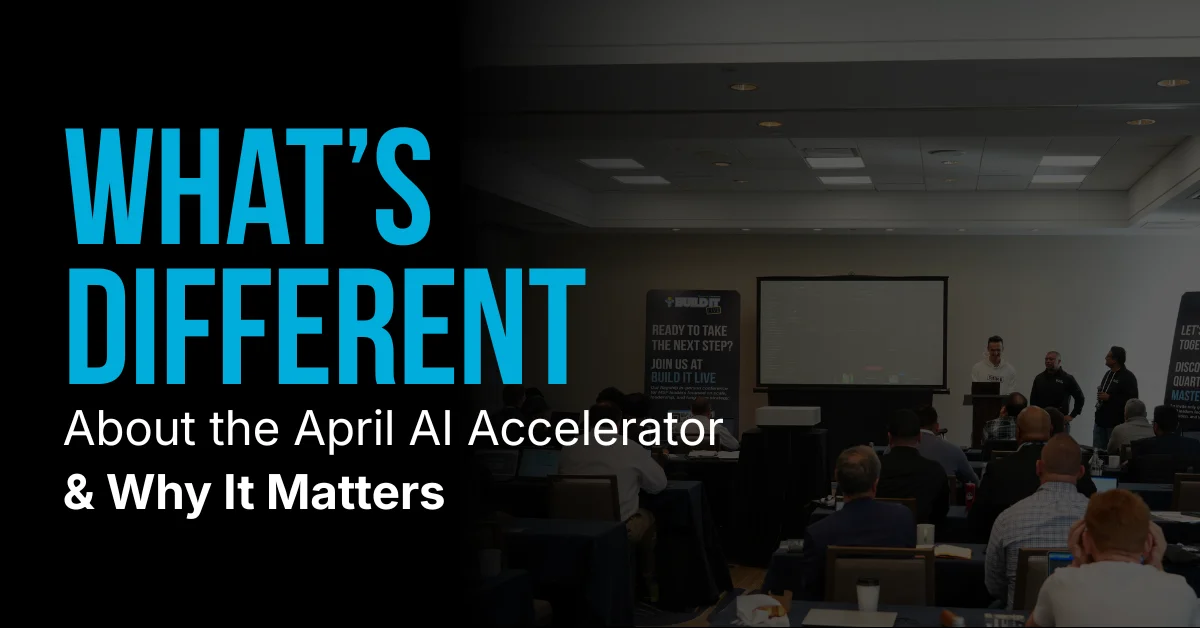
The AI Accelerator for MSP leaders is different because it moves beyond learning into execution. Instead of exposing leaders to tools or ideas, it focuses on integrating AI into real workflows, defining governance, assigning ownership, and building a 90-day execution plan. The result is measurable operational outcomes, not disconnected experiments that stall after initial momentum.
There’s no shortage of AI conversations happening across the MSP ecosystem right now.
Most leaders have already explored it. They’ve seen what tools can do. Many have tested automations internally or experimented with AI in service delivery, sales, or reporting.
And yet, for many MSPs, the impact still feels uneven. AI is present, but it is not embedded.
Work is changing in pockets, but not across the system.
That’s the gap.
And that’s exactly where the AI Accelerator for MSP leaders become relevant. Not because it introduces AI. But because it forces the harder shift, turning experimentation into execution.
Why Most AI Events Don’t Change How MSPs Actually Operate
Most AI events are designed to expand awareness. They introduce tools, trends, and possibilities.
That part works. The problem shows up after the event ends.
Leaders go back with ideas, but no clear structure for implementation. Daily operational pressure takes over. What felt actionable in the room becomes difficult to sustain in the business.
The result is familiar. AI gets applied in isolated areas. Teams experiment, but workflows don’t change. Decisions remain reactive rather than structured.
Over time, this creates a pattern of activity without operational shift. The issue is not a lack of intelligence or effort. It is the absence of a structured execution environment where decisions are translated into systems.
The Difference Between Learning AI and Installing It into Operations
There is a clear line that separates understanding AI from benefiting from it. Learning expands knowledge. Installation changes execution.
Installing AI into operations means making deliberate decisions about how work flows through the business.
It requires:
- Redesigning workflows so AI is embedded, not optional
- Defining ownership so outputs are accountable
- Establishing governance early to prevent rework
- Sequencing implementation so results compound
This is where most MSP AI implementation programs fall short. They stop at capability.
AI operationalization for MSPs begins when leaders commit to structure, not just exploration.
Why April AI Accelerator Session Exists
The April session exists because the problem has shifted. Earlier conversations in the market were about awareness. Today, most leaders are past that stage.
What surfaced instead is a different challenge.
- Leaders know what AI can do.
- They are unsure how to install it properly.
- The friction shows up in execution.
- What to implement first.
- How to integrate across systems.
- How to govern it without slowing progress.
April is designed to address exactly this phase.
It is not about introducing AI. It is about building it into your business model with clarity and sequencing.
What’s Structurally Different About April
The difference is not in the content. It is in how the session is structured.
This is not a presentation-driven event. It is a working environment where leaders actively build and design their AI implementation.
Across the two days, the structure is intentional.
Day 1 focuses on internal operations and foundations. Leaders work through how AI impacts margins, efficiency, and operational workflows. They see real automations inside PSA and RMM environments and begin building their own internal automation stack.
This includes practical areas such as:
- Ticket triage and routing
- Billing synchronization
- Security alert correlation
- Reporting and QBR preparation
The day also introduces governance early, covering risk, compliance, and decision accountability before scaling begins.
Day 2 shifts toward client-facing revenue and execution.
Leaders move from internal efficiency to external opportunity:
- Packaging and pricing AI services
- Positioning AI without becoming a software company
- Building acquisition and service delivery funnels
The session closes with a working plan, not a concept. Each leader builds a 90-day implementation and go-to-market roadmap aligned to their business.
This is what structured AI execution for MSPs actually looks like. It connects workflow integration, governance, and leadership accountability into one system.
What Leaders Actually Walk Away With
What matters most is not what happens in the room. It’s what leaders take back. This is where the April session stands apart. Leaders leave with clarity that translates directly into action.
They walk away with:
- A defined internal AI roadmap, not just ideas
- A set of automations already mapped to their operations
- A packaged AI service offering ready for clients
- A 90-day execution plan they can act on immediately
More importantly, they leave with alignment between strategy and execution. They understand what to do, in what order, and why it matters. That level of clarity is what turns AI from experimentation into measurable outcomes.
Who April is for and Who it’s not
Not every MSP is at the same stage. Some are still exploring AI, testing tools, and building awareness. That is a necessary phase.
April is built for a different moment. It is for leaders who are ready to move from exploration to installation.
Typically, this includes MSP owners, CEOs, and COOs who are responsible for:
- Strategic direction
- Operational performance
- Investment decisions
It is not about technical depth. It is about execution commitment. If AI is still a curiosity, this may not be the right fit. If AI is becoming a priority, and you need structure to implement it, that’s where the value becomes clear.
The Cost of Waiting to Operationalize
The cost of delay is rarely immediate. It shows up gradually.
MSPs that begin integrating AI into their operations start to see compounding benefits. Their workflows become more efficient. Their teams operate with more clarity. Their capacity increases without equivalent cost.
Over time, that creates separation. Meanwhile, continued experimentation without integration leads to a different outcome.
- Rework increases.
- Execution drifts.
- Opportunities are delayed.
The gap between those two paths widens over time.
This is not about moving faster for the sake of speed. It is about moving deliberately before the cost of delay compounds.
Wrap-Up: Are You Still Exploring or Ready to Install AI Into the System?
At some point, every MSP leader reaches a decision point. Continue exploring AI as a set of experiments. Or begin installing it into the operating system of the business.
If AI is still optional within your workflows, it has not yet become a competitive advantage.
Structured execution is what changes that. If you want to understand how that shift is approached in practice, you can explore the
AI Accelerator for MSP leaders and how it is designed around execution rather than exposure. The upcoming session takes place on April 13th and 14th, 2026, in Freehold, NJ.
No urgency attached. Just clarity on what the next step looks like.
Conclusion
AI is no longer about learning what is possible. It is about deciding how it becomes part of how your business runs.
What makes April different is not the topic. It is the structure. It is designed to help leaders move from scattered experimentation to deliberate execution.
For those ready to make that shift, the outcome is not subtle. It shows up in how workflows evolve, how decisions are made, and how results become measurable.
That is where AI starts to matter.
FAQs about April AI Accelerator
Q: What makes the AI Accelerator for MSP leaders different from other AI events?
A: It focuses on execution by helping leaders integrate AI into workflows with governance, sequencing, and measurable outcomes.
Q: What will actually build during the session?
A: You will build internal automations, define AI services, and create a 90-day implementation plan aligned to your business.
Q: Is this session technical or strategic?
A: It is designed for MSP leaders focused on strategy, operations, and execution, not deep technical training.
Q: What are the key outcomes after attending?
A: Clear execution sequencing, integrated workflows, defined governance, and a roadmap you can implement immediately.
Q: Who should attend this session?
A: MSP owners, CEOs, and COOs ready to move from AI experimentation to structured operational execution.