AI decision execution for MSPs has become unavoidable. Across the channel, MSP owners, CEOs, and COOs acknowledge that AI will influence margins, client expectations, and long-term relevance. Yet acknowledgement has not translated into execution.
Operational reality looks unchanged.
Service desks still absorb the same friction.
Documentation, QA, and escalation patterns feel familiar.
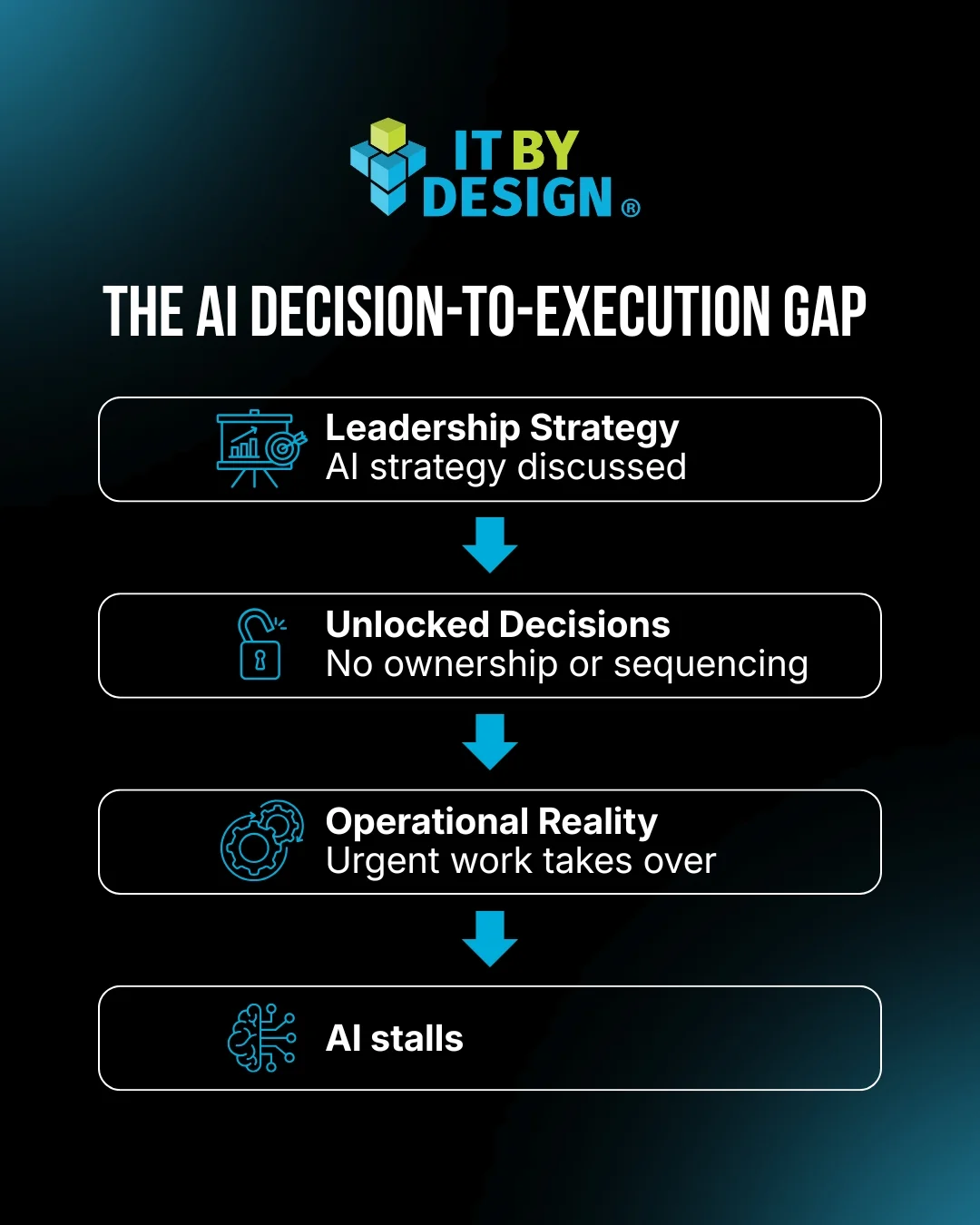
This gap points to a deeper breakdown in MSP AI decision making. AI is not failing because the technology is inaccessible. It is failing because leadership decisions are not surviving execution.
Industry research consistently shows that roughly 60 to 70 percent of strategic initiatives stall during execution, not because leaders choose the wrong ideas, but because ownership, sequencing, and accountability never fully lock. AI initiatives inside MSPs follow this same pattern, often more intensely due to operational pressure.
Why AI Discussions Do Not Turn Into Action Inside MSPs
AI initiatives inside MSPs rarely fail at the idea stage. They fail after the meeting ends.
Leadership teams explore AI use cases, debate risk, and review tools. The conversations sound decisive. Language signals intent. But once leaders return to daily operations, nothing changes.
- No workflow is explicitly altered.
- No capacity is deliberately freed.
- No execution owner is formally accountable.
Dean Lause has seen this pattern repeatedly. From his perspective:
AI stalls not because leaders lack interest, but because decisions remain abstract.
Without tying AI to a specific operational change, execution loses to the work that already feels urgent.
This is how execution gaps form. Not through resistance, but through ambiguity.
Why Leadership Agreement Does Not Create Execution
One of the most common breakdowns in AI strategy execution for MSPs is confusing agreement with commitment.
Most leadership teams agree AI matters. That alignment creates comfort. It reduces friction. It keeps meetings efficient.
Decisions force trade-offs:
- What work stops
- Who owns outcomes
- What happens if the initiative fails
Dean’s experience highlights a consistent reality. Leaders often avoid locking these trade-offs because MSP environments already feel stretched. Flexibility feels safer than commitment. Unfortunately, that flexibility prevents execution.
Agreement signals awareness. Decisions signal intent. Execution follows only the latter.
Where AI Execution Breaks Between Strategy and Operations
AI initiatives rarely break at vision. They break at translation.
At the leadership level, AI plans sound logical and contained. At the operational level, teams need specificity. When leaders do not translate intent into clear workflows, timelines, and ownership, teams interpret.
Each interpretation introduces delay.
Each delay erodes momentum.
Dean consistently emphasizes that AI cannot compensate for undocumented processes or unclear data ownership. When processes are not explicit, AI amplifies inconsistency instead of reducing it.
This is where many AI adoption failures originate. Not from lack of ambition, but from lack of operational language.
Why Daily MSP Operations Override Unclear AI Decision Execution?
MSPs operate under constant urgency. Client escalations, ticket queues, and reactive work dominate attention. In this environment, unclear priorities always lose.
AI initiatives that are not explicitly protected are displaced by work that feels safer and more concrete. This is not cultural resistance. It is rational behavior under pressure.
Operationalizing AI in MSPs requires decisions strong enough to survive daily noise. Vague initiatives do not compete with immediate client demands. Without deliberate sequencing and protected capacity, AI work disappears quietly.
This is not a tooling problem. It is a leadership one.
How Clarity Changes AI Decision Execution Outcomes
Execution improves when leaders decide clearly, visibly, and deliberately.
Decision clarity does not require complex frameworks. It requires locking four elements:
- What will be acted on now
- What will wait
- Who owns execution
- What changes in daily work
Dean repeatedly points out that AI only delivers value when anchored to a documented process. Without that foundation, outcomes remain unpredictable.
Once decisions are clear, teams stop guessing. AI work stops competing with everything else. Execution becomes predictable instead of aspirational.
This is the inflection point where MSP AI leadership moves from intent to behavior.
Why Structured Decision Making Matters More Than Speed
Many MSPs rush AI pilots assuming speed will compensate for uncertainty. It rarely does.
Speed without structure creates rework. Decisions reverse. Teams disengage. Industry data consistently shows that initiatives launched without clear ownership and governance are nearly twice as likely to be abandoned within the first year.
Deliberate structure produces the opposite outcome. Fewer initiatives move forward, but they stick. Ownership holds. Review cycles remain intact. Momentum compounds.
AI decision execution for MSPs improves when leaders slow decisions just enough to make them durable.
The Technical Requirements AI Execution Depends On
AI does not operate on ideas. It operates on structure.
Dean’s guidance is consistent. If a process is not documented, it is not ready for AI. AI systems require structured inputs, defined data boundaries, and predictable outputs. Without these, automation magnifies noise instead of reducing it.
This is why successful MSPs start internally. They focus on workflows where:
- Data already exists
- Repetition is high
- Risk is contained
Common entry points include ticket QA, first-call resolution support, documentation, and internal reporting. These areas allow teams to learn without exposing clients or core systems.
Technical success follows operational clarity, not the other way around.
Why AI Governance Must Precede Deployment
AI execution introduces new risk layers that many MSP leaders underestimate.
Dean highlights a recurring issue. Employees use public AI tools without understanding data exposure, unintentionally leaking proprietary or sensitive information.
Industry estimates suggest that over 40 percent of AI-related data exposure incidents originate from internal misuse rather than external attacks.
Execution-ready MSPs treat governance as foundational:
- Redacting sensitive data before AI ingestion
- Using controlled or private AI environments
- Restricting access by role
- Keeping humans in approval loops
AI without governance is not progress. It is unmanaged risk.
How Structured Working Environments Support AI Execution
Daily MSP operations are designed for responsiveness, not reflection. Tickets escalate. Clients interrupt. Internal priorities shift by the hour. In that environment, even well-intentioned leaders postpone difficult decisions, telling themselves they will revisit them when things calm down.
They rarely do.Structured working environments matter because they remove that escape hatch—creating space where AI decisions can be locked, owned, and translated into execution through a structured AI decision-to-execution environment. When leaders step out of daily firefighting, something predictable happens. Weak decisions surface quickly. Assumptions get challenged. Ownership gaps become impossible to ignore.
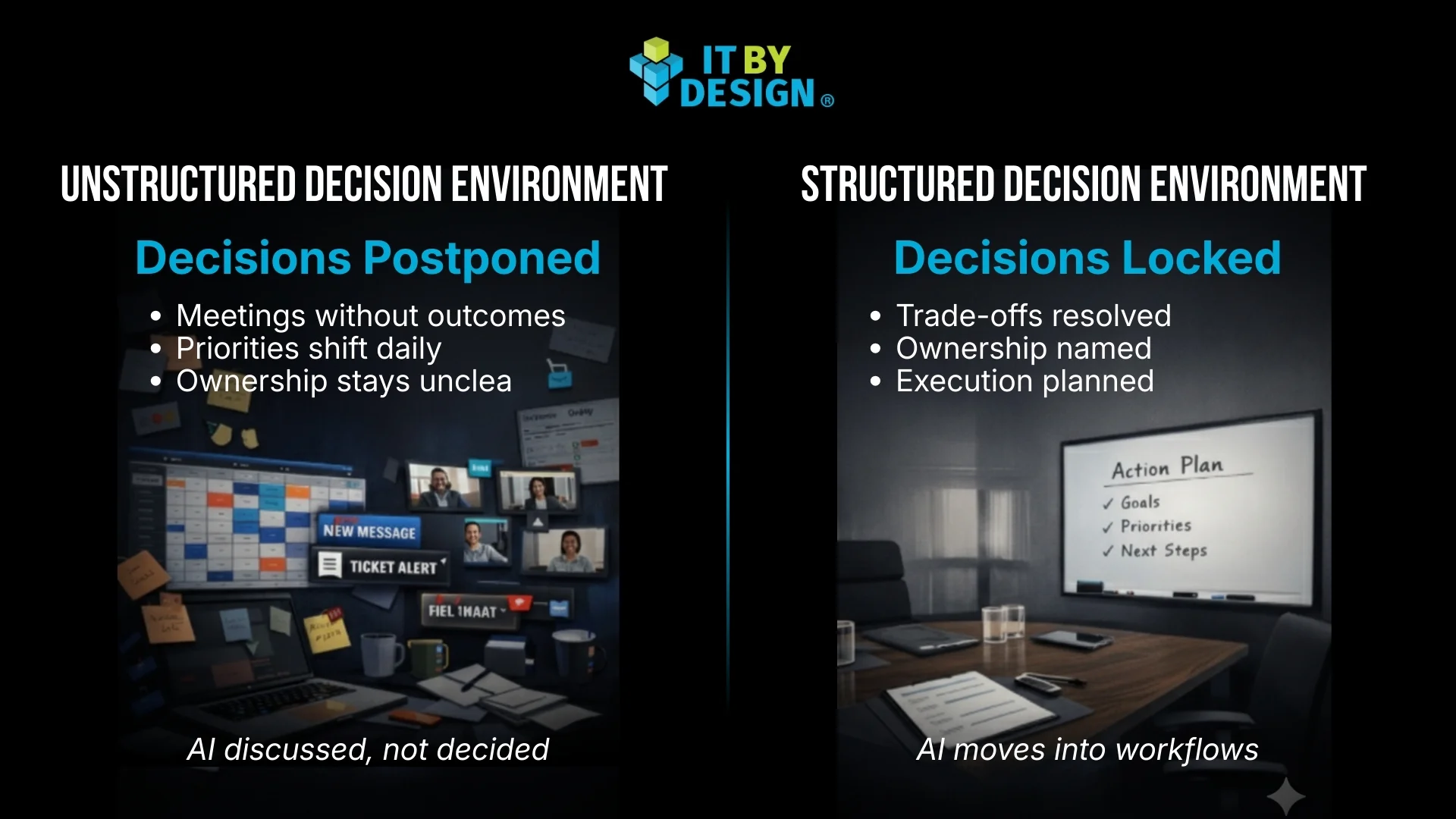
In unstructured settings, ambiguity hides. In structured ones, it is exposed.
This is where disciplined environments such as the In-Person AI Accelerator working room play a role. Not as a library of tools or a collection of templates, but as a decision-forcing space. The value is not the technology discussed. It is the discipline of deciding before execution begins.
Inside these environments, leaders are not allowed to say “we’ll figure that out later.” Trade-offs must be resolved. Priorities must be sequenced. Ownership must be named. What will not be worked on must be stated explicitly.
That is uncomfortable work. It is also the work most MSPs avoid while remaining trapped in discussion mode.
By the time AI decision execution initiatives leave a structured environment and return to daily operations, ambiguity has already been addressed. Teams are not asked to interpret intent. They are asked to execute decisions that have already been made. That difference explains why some AI efforts survive operational pressure while others quietly disappear.
Structured environments do not accelerate AI by adding urgency. They accelerate AI by removing uncertainty.
How MSP Leaders Can Tell If AI Is Actually Being Deployed
Execution leaves evidence. Conversation does not.
MSP leaders often say they are “working on AI” without being able to point to a single operational change. That gap is not philosophical. It is observable inside daily workflows.
There are four signals that reliably indicate whether AI has moved from discussion into deployment.
First, a specific AI decision execution plan has been locked this quarter
Not explored. Not piloted. Decided. This decision is narrow by design. It answers what will change now, not eventually.
Second, execution ownership is clearly named
One role. One person. Not a committee. That owner is accountable for outcomes, not experimentation.
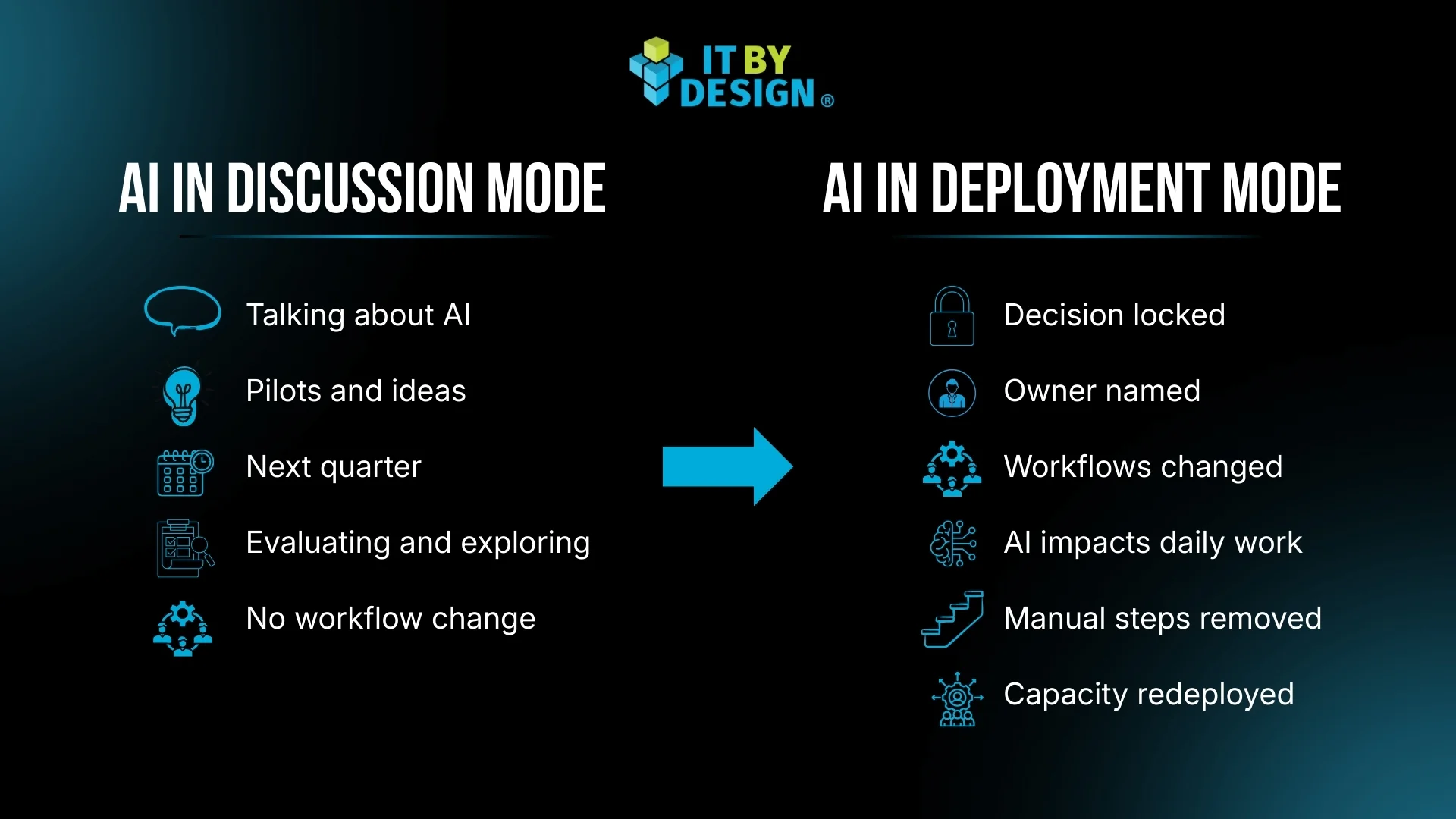
Third, at least one workflow looks different as a result
This is where many initiatives fail, because leaders struggle to define what “different” actually means.
In deployed environments, workflow change is visible and concrete:
- Documentation is no longer written from scratch; AI assists with first-pass creation and standardization.
- Ticket intake is classified or summarized automatically before a technician touches it.
- QA reviews flag incomplete notes, missing time entries, or inconsistent resolution language.
- First-call resolution improves because technicians receive contextual prompts in real time.
- Reporting shifts from manual compilation to automated summaries that highlight exceptions.
If AI does not show up at this level, it is not deployed. It is still theoretical.
Fourth, something has been deliberately stopped
Manual steps are removed. Redundant reviews disappear. Capacity is freed. Trade-offs are honored. This is the hardest signal, and the most important.
When leaders cannot answer these four points cleanly, AI is not deployed yet. It is still aspirational.
This realization is often uncomfortable because it reframes the problem. The issue is not budget. It is not tooling. It is not timing. It is decision discipline.
For many leadership teams, this moment becomes a turning point. It explains why structured environments that prioritize decisions over experimentation become attractive. Not because leaders want more ideas, but because they need clarity strong enough to survive execution.
Why AI Execution Is a Leadership Responsibility
When AI stalls, leaders often look outward for explanations. The tools were not mature enough. The team was not ready. The timing was off.
Dean’s experience consistently points to a different conclusion. AI adoption failures almost always trace back to leadership behavior. Unclear ownership. Shifting priorities. Decisions that were never fully made.
Tools do not compensate for ambiguity. Pilots do not fix avoided trade-offs. Experiments do not replace accountability.
Execution improves when leaders fix decision clarity. It improves when they decide what matters now, what waits, and who owns outcomes. It improves when leadership behavior becomes predictable.
This is not a technology problem. It is a leadership one.
Why AI Execution Is a Leadership Responsibility
When AI stalls, leaders often look outward for explanations. The tools were not mature enough. The team was not ready. The timing was off.
Dean’s experience consistently points to a different conclusion. AI adoption failures almost always trace back to leadership behavior. Unclear ownership. Shifting priorities. Decisions that were never fully made.
Tools do not compensate for ambiguity. Pilots do not fix avoided trade-offs. Experiments do not replace accountability.
Execution improves when leaders fix decision clarity. It improves when they decide what matters now, what waits, and who owns outcomes. It improves when leadership behavior becomes predictable.
This is not a technology problem. It is a leadership one.
What MSP Leaders Must Rethink About AI Deployment
If AI decision execution plan only exists in conversations, deployment has not started.
AI decision execution for MSPs begins when leaders decide clearly, deliberately, and visibly. Not everything at once. Not perfectly. Just enough to force operational follow-through.
The real payoff is not novelty or experimentation. It is calmer teams who know what matters. Clearer priorities that do not change weekly. Work that actually looks different than it did before.
This is also where structured leadership environments begin to matter more than internal meetings. In daily operations, AI decisions compete with urgent work. In structured settings like the AI Accelerator working room, leaders step out of noise and focus on execution design.
These environments are not about learning more tools. They are about mapping AI into real workflows:
- Identifying which processes are stable enough for AI assistance
- Defining data boundaries and governance before automation begins
- Deciding where humans stay in the loop and where they do not
- Locking ownership and review cadence before deployment
By the time AI initiatives return to daily operations, the work is already shaped. Ambiguity has been removed. Teams are not asked to interpret intent. They are asked to execute decisions.
AI succeeds when it reduces friction, not when it creates more discussion.
This is why some MSP leaders eventually seek out executive masterminds or decision-focused working environments. Not to escape responsibility, but to meet it with clarity.