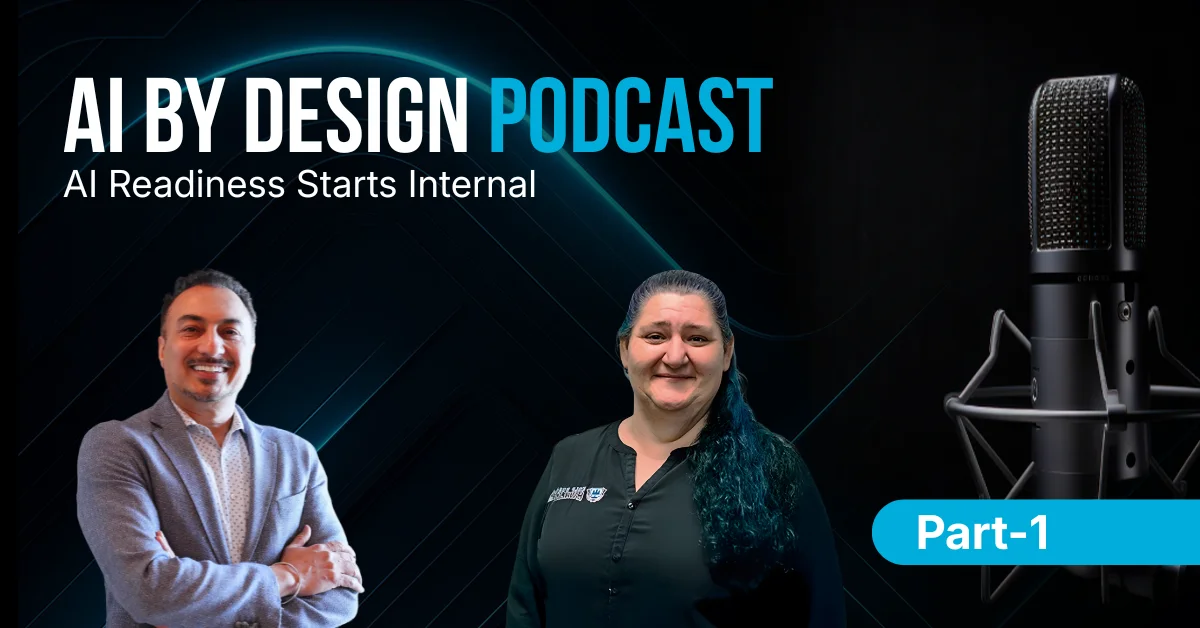
AI governance for MSPs is no longer optional. In this second part of my conversation with Kim Brys on AI By Design, we moved from internal AI foundations to a harder reality: clients are already looking for guidance on responsible AI adoption, and not every MSP is prepared to provide it.
In Part 1, we talked about documentation, operational clarity, and why AI success starts internally. In this part, we addressed what happens when MSPs delay building AI capability.
Because the market is not waiting.
The Real Example That Changed the Tone of the Conversation
During the episode, I shared a recent experience that genuinely surprised me.
A business owner reached out to me directly asking for help with AI. As an MSP-focused organization, we do not take direct customers, so my first step was to refer them back to their provider.
I asked them a simple question: “Is your MSP helping you with AI?”
The answer was no.
They had an MSP.
But their MSP did not have an AI practice.
They were not offering AI awareness training.
They had no AI use policy.
There was no governance framework in place.
Meanwhile, employees inside that organization were already using ChatGPT on individual accounts, with no guardrails and no centralized oversight.
What stood out to me was how basic the request was.
They were not asking for advanced AI engineering. They were asking for responsible AI adoption with cybersecurity at the center. They wanted guidance similar to what MSPs already provide in security awareness training:
- Help their team understand AI usage
- Establish governance guardrails
- Create a centralized corporate AI structure
- Reduce risk from uncontrolled usage
And the MSP said no.
I told Kim during the episode that I was genuinely surprised. Not because AI is new, but because this is no longer a “nice to have.” It is quickly becoming part of the responsibility of being a trusted technology partner.
Why This Is Bigger Than One Account
As we continued the conversation, it became clear that this example is not isolated.
AI questions are showing up in QBRs. Clients are asking about efficiency, automation, and risk. They want to know how AI fits into their business without exposing them to data leakage or compliance issues.
If you cannot answer those questions, your positioning shifts.
You are no longer seen as the strategic advisor guiding technology decisions. You become reactive.
And here is the part that MSP leaders need to think about carefully: if another provider enters that account offering AI capability and governance guidance, they are not just solving one problem. They are building trust.
And trust expands.
That is how accounts evolve over time.
AI Is a Skill That Must Be Developed
One of the clearest points in this episode was this: AI is a skill, not a piece of software.
You do not “install” AI capability the way you install a firewall. You build it.
You develop internal understanding of prompting.
You create governance frameworks.
You align AI usage with cybersecurity standards.
You experiment internally before advising externally.
Just as MSPs built expertise in cloud services and cybersecurity, AI capability must be developed intentionally.
If you do not understand it, you cannot confidently guide your clients through it.
And your clients are already experimenting.
Why the Sequence Still Starts Internally
Kim’s message in both parts of this conversation was consistent: start internal.
Before you attempt to sell AI services, operationalize AI inside your own MSP.
Look across your departments:
Helpdesk.
Dispatch.
Finance.
HR.
Marketing.
Ask where the biggest constraint exists. Ask whether AI can reduce friction, improve clarity, or lower stress.
You do not need to solve 100 use cases. In fact, trying to do too much creates confusion. Start with one low-effort, high-impact opportunity.
Build that success.
Document it.
Refine it.
Then share the story with your clients.
Because every business has similar internal functions. When you become customer zero, you earn the right to guide.
That is how you move from vendor to trusted AI advisor.
What This Means for MSP Leaders
AI is not just another service category to add to your website. It is becoming part of the baseline expectation for strategic technology partners.
Clients are looking for guidance on:
- Responsible AI adoption
- AI governance frameworks
- Secure usage policies
- Operational efficiency
If MSPs ignore this shift, they risk more than a missed revenue opportunity. They risk losing relevance in strategic conversations.
That is why this is not about chasing trends. It is about protecting positioning.
One Practical Step to Take
If you want to act on this episode, keep it simple.
Bring your leadership team together and ask:
- Where are we already using AI internally?
- Do we have governance guardrails in place?
- What is one operational bottleneck where AI can deliver measurable improvement within 30 days?
Start there.
Execution creates confidence.
Confidence builds advisory strength.
Final Thought
AI will not replace managed service providers.
But MSPs who choose not to build AI capability, governance awareness, and internal proof may find themselves outside the most important conversations.
The firms that lead will not be those who talk about AI the most.
They will be the ones who build the skill, apply it internally, and guide their clients with clarity.
That is the difference between reacting to change and leading it.
And that is what we discussed in Part 2 of AI By Design.
Feel free to subscribe to AI By Design to stay tuned in for more such insights!