AI adoption for MSPs is one of the most talked-about topics in the channel right now. But in my conversations with leaders across the industry, I’m seeing a very different reality: curiosity is high, yet true commitment is still early.
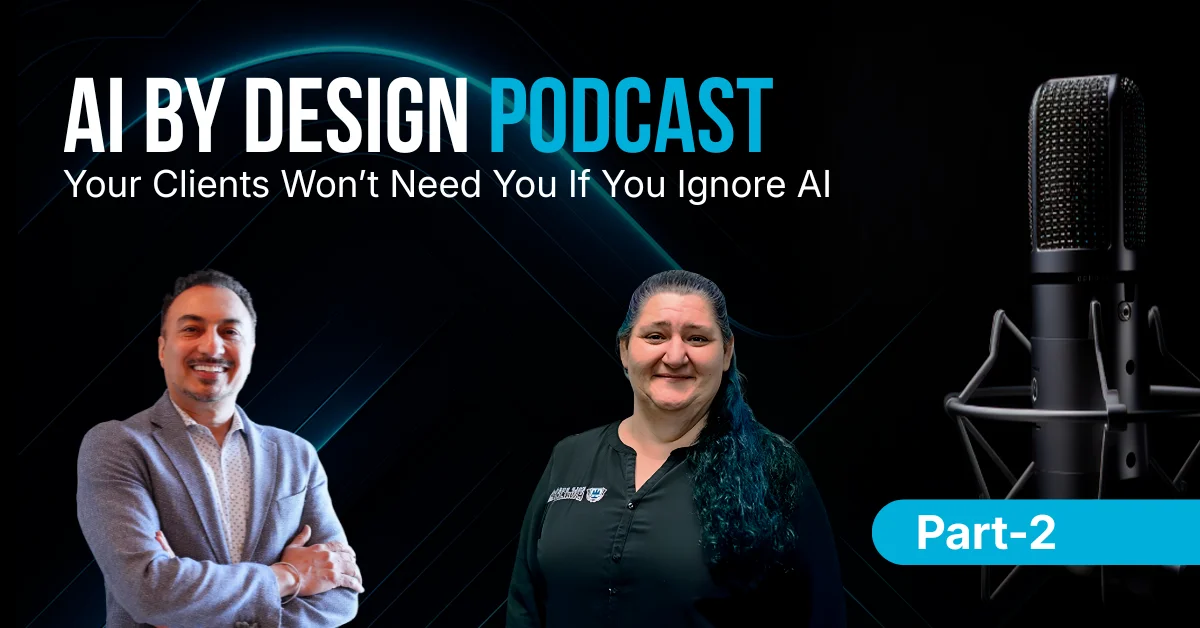
I recently spoke with my friend Sanjay Khosla, CEO of Blueprint Helpdesk, about what AI looks like in MSPs today on an episode of AI By Design. What began as a straightforward meeting swiftly evolved into a more in-depth chat on operational discipline, readiness, and the true opportunities for MSP executives.
And one thing became very clear: the market is moving faster than most providers realize.
Why Most MSPs Haven’t Fully Committed to AI Yet
When I asked Sanjay about the state of AI in the channel, his answer was refreshingly honest.
Many MSPs are still overwhelmed running their businesses. Between service delivery, customer support, cybersecurity pressures, and operational complexity, AI often feels like something they’ll “get to later.”
From the conversations he’s having with peers across the industry, the pattern is clear:
- AI curiosity exists
- AI experimentation is happening
- But serious AI adoption inside MSP operations is still low
This doesn’t mean MSP leaders don’t see the potential.
It means the industry is still figuring out where to start.
And honestly, that’s exactly where most technology transformations begin.
What AI Adoption Looks Like in the SMB Market
The situation on the customer side of the market is surprisingly similar.
Sanjay described what many MSPs are seeing with their SMB clients:
Teams are already experimenting with tools like ChatGPT and other AI assistants, often through individual free accounts. Employees are using them for:
- Writing emails
- Drafting marketing content
- Summarizing information
- Generating documents
But in most organizations, there’s no structured approach yet.
Leadership knows AI can help them:
- reduce operational costs
- improve productivity
- increase revenue
They just don’t know how to operationalize it safely and effectively.
From my perspective, this is exactly where MSPs can step in as trusted advisors.
But only if they build the capability internally first.
Why I Believe AI Is a Skill, Not Just a Tool
During the conversation, I emphasized something I repeat often when talking about AI with MSP leaders:
AI is a skill, not a piece of software.
You don’t “install” AI the way you deploy a firewall or a backup system.
You develop capability.
And that capability starts with something surprisingly simple: prompting.
To get quality results from an Artificial Intelligence system, the quality of the prompt presented to it is vital. The ability to formulate good questions and to structure the context in a meaningful way is essential for building an effective Artificial Intelligence application that would direct the AI to a desirable outcome.
For many teams, improving prompting skills is the first meaningful step in building AI competency.
But prompting alone isn’t enough.
The real value comes when AI starts improving operational workflows.
How One MSP Is Using AI Inside Their Operations
One of the reasons I enjoyed this conversation with Sanjay is that he didn’t talk about AI hypothetically.
He talked about real operational use cases his team is already working on.
Their approach is simple: start small and build momentum.
Some of the early AI initiatives inside Blueprint Helpdesk include:
Workflow Automation
Their team is beginning with small automations, such as combining spreadsheet data and identifying devices that haven’t been online for extended periods.
This allows them to proactively notify customers and maintain visibility across their environments.
Automating Business Reviews
They are also exploring ways to streamline Quarterly Business Reviews (QBRs) and Technology Business Reviews (TBRs).
These reviews often involve large amounts of operational data, and AI can help summarize insights, identify trends, and prepare reports faster.
For MSPs, this is one of the most practical early use cases for AI.
Closing Revenue Leakage
One challenge Sanjay highlighted resonated with many MSPs: license billing accuracy.
It’s surprisingly common for MSPs to lose revenue because licenses are not perfectly tracked or billed.
AI-driven analysis can help detect discrepancies and ensure:
- licenses are properly accounted for
- billing is accurate
- revenue leakage is minimized
That’s a direct operational win.
AI-Driven Ticket Triage
Another initiative his team is exploring is AI-assisted ticket triage.
This involves using AI to analyze incoming tickets and automatically prioritize or route them, helping technicians focus on the highest-impact issues first.
For service teams, that kind of operational efficiency compounds quickly.
Sales and Marketing Automation
On the business development side, Sanjay’s team is integrating HubSpot with ConnectWise so opportunities automatically move through their systems.
This creates better visibility, fewer manual steps, and more reliable sales workflows.
These are not futuristic AI experiments.
They’re practical operational improvements.
Where the Biggest AI Opportunity for MSPs Actually Exists
Many people think AI opportunity in the channel will come primarily from selling AI services to customers.
But I see it differently.
The biggest opportunity starts inside the MSP itself.
Before you can confidently guide clients through AI adoption, you need internal experience in areas like:
- workflow automation
- data analysis
- operational reporting
- internal productivity improvements
When you apply AI internally first, two things happen:
- You develop real operational expertise
- You gain stories and proof points to share with clients
That’s how MSPs move from vendor to strategic advisor.
And that’s how AI becomes a long-term growth engine instead of just another tool.
Why Governance Will Become the Next Major Conversation
As our discussion continued, another important topic surfaced: AI governance.
Right now, many organizations are experimenting with AI informally.
But experimentation without guardrails creates risk.
Companies need to think about:
- how employees are using AI
- what data can be shared with AI systems
- how AI outputs are reviewed and validated
- what policies guide responsible AI usage
This is where MSPs can play a critical role.
Just as providers helped organizations adopt cybersecurity frameworks, they will increasingly guide clients through AI governance and responsible usage.
But again, that requires internal maturity first.
What This Means for MSP Leaders Right Now
If you’re running an MSP today, you don’t need to solve everything about AI immediately.
But you do need to start building capability.
From my perspective, the most practical first steps are:
- Build AI awareness inside your leadership team
- Develop prompting and experimentation skills
- Identify one operational workflow to improve with AI
- Document the results and refine the process
Execution builds confidence.
Confidence builds expertise.
And expertise builds advisory credibility with clients.
The MSPs who lead the next phase of the industry won’t necessarily be the ones talking about AI the most.
They’ll be the ones quietly building the skill, applying it internally, and guiding their customers with clarity.
Final Thought
My conversation with Sanjay reinforced something I see across the industry.
AI isn’t arriving someday.
It’s already here.
Employees are experimenting with it. Businesses are asking about it. And the expectations around technology partners are evolving quickly.
MSPs who take the time to build AI capability internally today will be the ones best positioned to lead tomorrow.
And that’s exactly why I started these conversations on AI By Design.
More insights from the series are coming soon. Stay tuned.