AI adoption for MSPs often begins with internal experimentation. But sooner or later, every MSP leader faces the same question: how do you take AI to market?
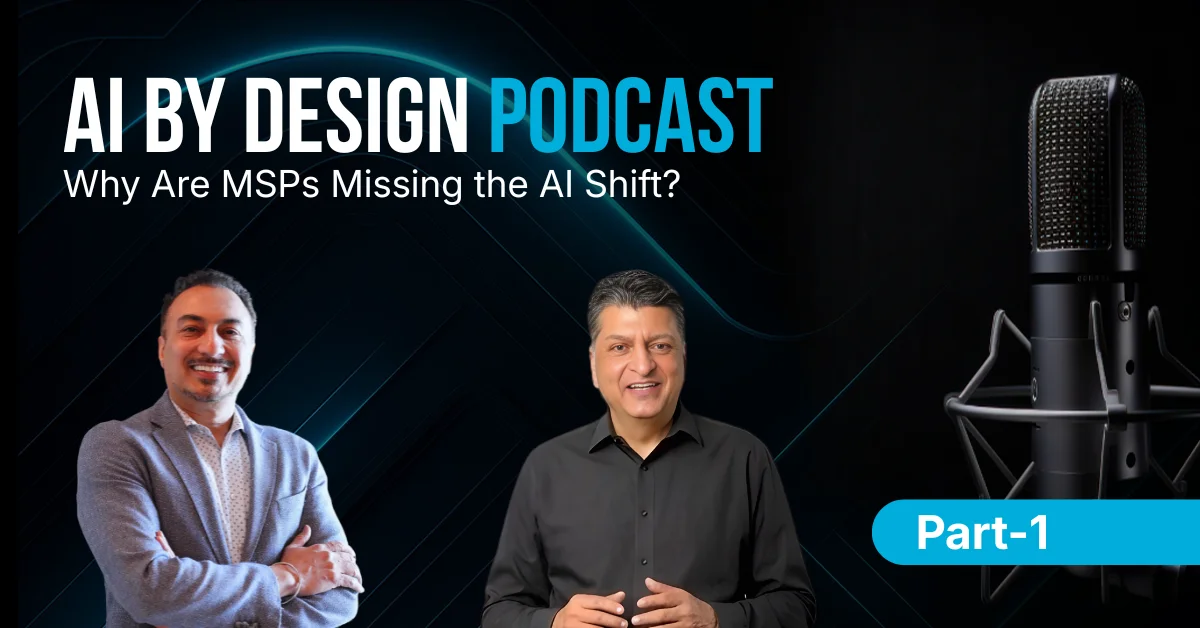
In the first part of my conversation with Sanjay Khosla, CEO of Blueprint Helpdesk, we talked about where AI adoption really stands in the MSP industry today. Curiosity is high. Experimentation is happening. But operational adoption is still early for many providers.
What stood out to me most, though, was Sanjay’s mindset.
He isn’t approaching AI with hesitation or fear. He’s looking at it as an opportunity to rethink how MSPs operate, grow, and serve their customers.
And that’s where the second part of our conversation on AI By Design became even more interesting.
We moved beyond internal AI experimentation and started discussing something far more practical:
How MSPs can build a real go-to-market strategy around AI.
Why AI Adoption for MSPs Should Start with Existing Customers
When I asked Sanjay how he plans to take AI to market, his answer was simple and pragmatic.
Start with the customers who already trust you.
Instead of making large scale AI advances at the beginning, they are working directly with existing customers to get started. They have already spoken with those customers about how AI might help them.
And the response has been encouraging.
Customers are excited. They’re curious about the possibilities.
But like many organizations today, they’re also unsure where to begin.
That’s why Sanjay’s strategy focuses on building confidence step by step, rather than pushing a big transformation all at once.
The journey begins with something many MSPs overlook: education.
Why AI Education Is the First Step in Customer Adoption
Before implementing AI tools or automation, Sanjay believes businesses need to understand what AI is, and what it can realistically do.
So, the first phase of their customer engagement focuses on training.
They plan to help clients understand:
- the fundamentals of AI
- how prompting works
- how workflows can be improved with AI
- what AI agents can do
This education component matters more than most people realize.
Without it, companies often treat AI like a novelty tool rather than a real operational capability.
But once teams understand how AI works – and what it can do for them – their mindset shifts. They begin to see opportunities inside their own workflows.
And that’s when things start getting interesting.
How MSPs Can Introduce AI Inside Customer Environments
After building awareness and understanding, the next step is to introduce AI directly into the customer environment.
One of the first things Sanjay’s team plans to do is give customers AI-powered access to their own business data through conversational interfaces.
Instead of manually digging through dashboards and reports, teams will be able to interact with their data through chat.
They can ask questions.
Analyze information.
Look at their business insights differently.
For many organizations, this alone creates immediate value.
But Sanjay doesn’t plan to stop there.
The next step in their approach is introducing small workflow automations.
These automations are intentionally simple. The goal is not to overwhelm customers but to help them experience practical improvements in productivity.
Small wins build confidence.
And confidence accelerates adoption.
How AI Agents Will Eventually Support Business Operations
As organizations become more comfortable with AI tools and automation, the next stage of the journey becomes possible: AI agents.
Agents can assist businesses by automating repetitive processes, supporting teams with operational tasks, and helping organizations work more efficiently.
But Sanjay is very realistic about how this transition happens.
It doesn’t happen overnight.
He described the process as one that requires guidance and a lot of hand-holding along the way.
Customers move through stages:
- Awareness and education
- Access to AI tools and data
- Workflow automation
- AI agents supporting operations
Each step builds trust.
Each step builds confidence.
And eventually, businesses begin to see AI not as a tool, but as an operational advantage.
How This AI Framework Can Also Attract New Customers
Once Blueprint Helpdesk refines this approach with existing customers, Sanjay plans to apply the same framework to prospective clients.
The structure remains the same:
Start with education.
Introduce AI tools.
Then move into workflows and agents.
This turns AI adoption into a clear, guided journey instead of a confusing technology experiment.
And that’s exactly where MSPs can differentiate themselves.
Not just by selling technology; but by guiding businesses through change.
Why AI Is Becoming a Core Growth Engine for MSPs
During our conversation, I also asked Sanjay how AI fits into his broader business strategy.
His answer was direct.
While Blueprint Helpdesk will continue delivering traditional MSP services, they’re also building something new: an AI-focused agency.
The goal is to help customers implement AI solutions and navigate their AI journey more effectively.
In fact, Sanjay shared something that really caught my attention.
Approximately 75% of their future marketing and sales initiatives will focus on AI services.
That’s not a side project.
That’s a strategic shift.
And it reflects something many forward-thinking MSP leaders are starting to recognize: the opportunity around AI is enormous.
How AI Can Improve MSP Service Margins
Another topic we discussed was the operational impact of AI inside MSP businesses.
Sanjay’s team is already thinking about how AI can improve internal efficiency.
That includes:
- improving prompting techniques to get better results from AI systems
- implementing AI agents to automate repetitive tasks
- streamlining internal workflows
- supporting service delivery teams with smarter tools
These improvements don’t just increase productivity.
They can also improve service margins.
When routine work becomes automated and information becomes easier to access, technicians can spend more time solving higher-value problems.
And that operational leverage compounds over time.
Why AI Governance Must Be Part of the Strategy
One of the most important topics we discussed during the episode was AI governance.
Right now, many organizations are experimenting with AI informally. Employees are using tools like ChatGPT for writing, research, and productivity tasks.
But experimentation without guardrails can create risk.
Organizations need to think carefully about:
- how employees use AI tools
- what data can be shared with AI systems
- how AI outputs should be reviewed
- what internal policies guide responsible AI usage
In other words, AI adoption should begin with a governance-first mindset.
Security and responsible usage frameworks are not optional. They are foundational.
And MSPs have a major opportunity to guide their clients through this process.
The Mindset That Will Define the Next Generation of MSPs
As our conversation progressed, one thing became clear to me.
Many leaders in the channel are still approaching AI cautiously. They worry about disruption or uncertainty.
But Sanjay’s mindset is different.
Instead of asking what AI might do to his business, he’s asking:
How can AI help us grow faster and serve our customers better?
That mindset is powerful.
Because technology transitions rarely reward the most cautious companies.
They reward the ones willing to learn early and move forward.
One Piece of Advice Every MSP Leader Should Take Seriously
Before we wrapped up the episode, I asked Sanjay one final question.
If MSP leaders listening to the podcast could take one actionable lesson away from the conversation, what would it be?
His answer was simple.
Don’t try to navigate AI alone.
AI is evolving incredibly fast. Trying to figure everything out independently often leads to wasted time and lost momentum.
Instead, Sanjay recommends partnering with people who already have experience in AI.
When you surround yourself with people who are slightly ahead in the journey, you accelerate your own learning.
You learn from their successes.
And sometimes more importantly, you learn from the mistakes they’ve already made.
Closing Thoughts
My conversation with Sanjay reinforced something I’m seeing across the industry.
AI isn’t a future trend.
It’s already shaping how businesses operate and how technology partners deliver value.
The MSPs who start building real AI capability today will be the ones best positioned to guide their customers tomorrow.
Subscribe to my channel for more such thought leadership insights on AI, MSP landscape and what’s working in the channel.