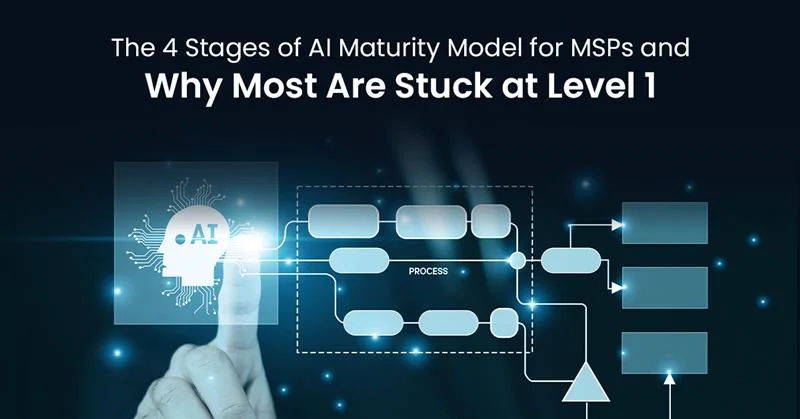
Most MSP leaders are experimenting with AI tools but not seeing the ROI they expected. They try Copilot, ChatGPT, or automation plugins, yet nothing truly changes in their margins, ticket queues, or service delivery. This is the difference between dabbling in AI and maturing through an AI maturity model.
Right now, most MSPs sit at Level 1 on the AI maturity stages because they lack the workflows, training, and accountability required to turn experimentation into predictable outcomes. And here is the real problem: staying stuck at Level 1 is costing MSPs time, talent, and EBITDA.
The good news is that once an MSP begins moving through the levels of AI maturity, everything gets better. Faster service delivery, higher efficiency, fewer escalations, and the beginnings of an AI-powered revenue engine. That is exactly why the AI Leadership Accelerator helps MSPs jump from Level 1 to Level 3 in just a few weeks.
Let’s break down the full AI maturity model, why it matters, and what’s keeping most MSPs from advancing.
What is the AI Maturity Model for MSPs (And Why it Matters in 2025)
The AI maturity model is a clear, practical way for MSPs to understand how far along they are in using AI to streamline operations, reduce labor, and improve customer experience. It moves MSPs from testing tools to building AI-enabled operations.
The real ROI shows up when:
- Workflows are automated
- Engineers consistently adopt AI
- Processes improve instead of relying on tribal knowledge
- Outcomes become measurable
If MSPs want better margins, fewer escalations, and stronger valuation, maturity is the path.
Stage 0- AI Curious
Stage 0 is where most MSPs start. Engineers test Copilot or ChatGPT on their own time, usually between tickets. There are no guidelines, no documented workflows, and no leadership direction. AI feels interesting, not operational.
Common signs you are at Stage 0:
- Engineers “play around” with different tools
- No clarity on what is allowed
- No AI training
- No use case library
- No measurable outcomes
Why MSPs Get Stuck at Stage 0
The jump from curiosity to operational AI requires structure, and most MSPs don’t have it yet. Time constraints, skepticism, lack of ownership, and no direct tie to business outcomes keep teams from progressing.
At Stage 0, AI feels like a side project rather than a lever for efficiency. That’s why MSPs often stay here longer than they realize.
Stage 1- AI Aware
Stage 1 is where most MSPs stop. Engineers start using AI for small, individual tasks like ticket summaries or scripting. But the usage is inconsistent and depends on personal habits rather than standardized processes.
You’ll see:
- Ticket summaries written with AI
- Occasional scripting support
- Better documentation
- Engineers using AI “when needed”
- No cross-team usage
Why Most MSPs Never Move Beyond Stage 1
The problem is not the tools. It’s the lack of structure behind them. Without workflows, training, and measurement, AI stays fragmented.
The Hidden Costs of Staying at Stage 1
Stage 1 feels productive, but it quietly drains the business:
- Rising labor costs
- Flat EBITDA
- More escalations
- Slow SLAs
Stage 1 creates an illusion of progress, but no real transformation. This is the danger zone for MSPs.
Stage 2- AI Adopting
Stage 2 is the first level where MSPs see real ROI. AI becomes part of daily work, not a tool used occasionally. Playbooks appear, SOPs improve, and adoption spreads across teams.
Signs you’re at Stage 2:
- 3–5 workflows automated
- AI built into ticketing, documentation, troubleshooting
- Consistent team adoption
- Training systems emerge
- Leadership reinforces usage
What Changes at This Stage
MSPs at Stage 2 experience practical wins:
- 15–20 percent faster ticket resolutions
- Reduced reliance on senior engineers
- Better first-call resolution
- SLA improvements
Stage 2 is the tipping point. This is where MSPs finally feel the impact of operational AI.
Stage 3- AI Mature
This is where the business transformation becomes obvious. AI is no longer optional. It becomes woven into culture, workflows, and service delivery. Teams rely on automation as a natural part of operations.
You’ll see:
- AI embedded in 7–10 workflows
- Team-wide adoption
- Dedicated AI champions
- BIT tracking real outcomes
- Automation-first service desk
Tangible Business Outcomes
MSPs at this level achieve:
- 15–30 hours saved per week
- 12–18 percent EBITDA lift within 12 months
- Lower engineer burnout
- High client retention
Stage 3 is what separates Managed Service Providers from Managed Intelligence Providers.
Why Most MSPs Never Escape Level 1
Many MSPs invest in AI tools but never invest in the structure required for AI maturity. Leadership often assumes tool adoption will happen naturally, but that rarely occurs. Engineers resist change without training, clarity, and accountability. As a result, usage becomes scattered and inconsistent across the service desk.
Another major roadblock is the absence of standardized workflows. When every engineer uses AI differently, results vary wildly. This inconsistency causes mistrust, which slows adoption even more. Without a workflow library or playbooks, AI never moves beyond personal experimentation.
There is also a lack of measurement. MSPs rarely track ticket time reductions, escalation impact, or SLA improvement tied to AI usage. Without metrics, leadership sees no proof of value, and investment stalls. AI ends up feeling optional rather than essential.
Finally, MSPs do not assign an AI owner or champion. Without someone driving training, building use cases, and checking adoption, the effort fades. Momentum dies, and AI becomes another tool sitting in the drawer.
How MSPs Can Move from Level 1 to Level 3 in 90 Days
The fastest way to level up is to start with the AI Leadership Accelerator for MSPs, which uses a simple 4G framework.
- Grow focuses on building AI powered revenue engines across sales, marketing, and account management.
- Gross Profit helps MSPs use AI to improve service delivery, so margins rise.
- Go to Market supports MSPs in pricing and packaging Managed AI Services.
- Govern ensures AI is adopted responsibly with security and policy alignment.
The Accelerator provides a complete 30-day 4G plan that becomes the MSPs 90-day AI roadmap. After graduating, leaders join the AI MSP Masterminds and Peer Groups where they refine their roadmap, compare what works across other MSPs, and stay ahead as AI evolves.
This structure is what moves MSPs from experimentation to measurable AI maturity.
Final Thoughts: The Future of MSPs Belongs to the AI Mature
The MSPs who will win in 2025 are not the ones buying the most AI tools, but the ones building real AI maturity. When workflows, teams, and processes are aligned, AI becomes a driver of faster resolutions, stronger margins, and a measurable competitive advantage.
AI maturity always outperforms AI experimentation. MSPs that invest in structure, training, and consistent adoption rise above competitors still relying on manual, inconsistent processes. The sooner MSPs prioritize maturity over tool testing, the sooner they unlock smoother service delivery, happier teams, and stronger valuation.
The message is simple. Tools don’t create transformation. Maturity does.
Want to Become an AI Mature MSP? Start With the Accelerator
The Accelerator gives MSP leaders everything needed to level up fast:
- A 90-day AI roadmap
- Proven workflow library
- Team adoption training
- Leadership accountability
- Early access to AI Native Peer Groups
The path to Level 3 starts here.
FAQs about AI Maturity Model
Q: What is an AI maturity model?
A: It is a framework that helps MSPs measure how advanced they are in adopting and operationalizing AI.
Q: How long does it take an MSP to move from Level 1 to Level 3?
A: With structure and accountability, most MSPs progress within 60 to 90 days.
Q: Why do MSPs get stuck at Level 1?
A: Because they rely on tools instead of workflows, training, and measurement needed for maturity.