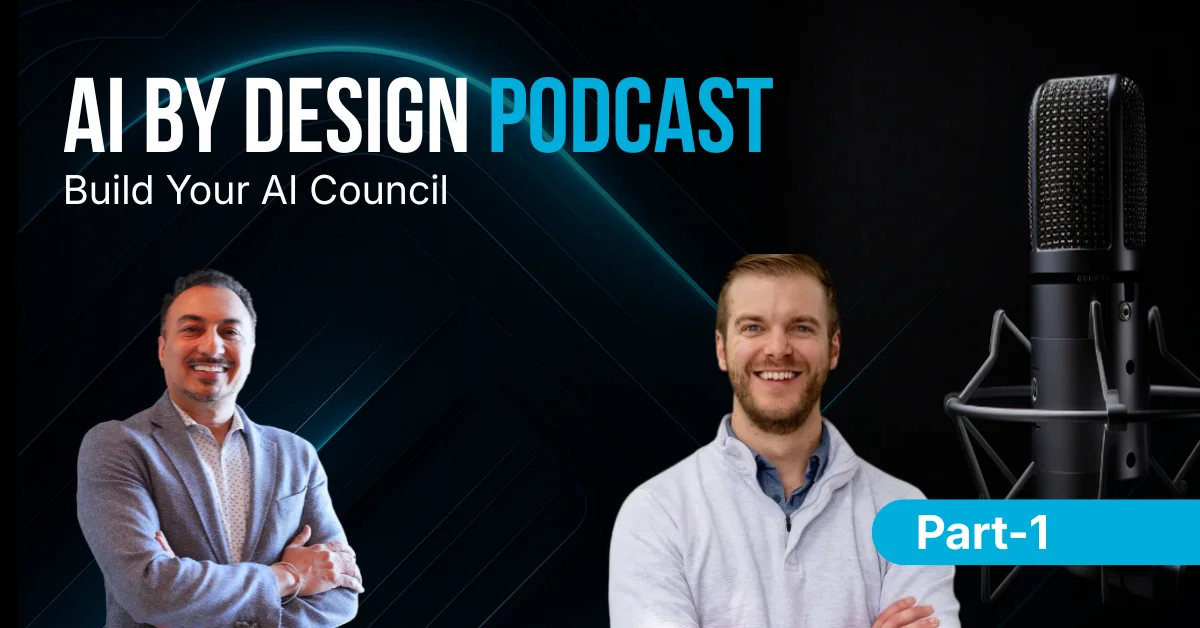
John Harden has been close to AI longer than most.
He sold his last business. Spent three years at Auvik leading work across business, product, strategy, and AI implementation. Took time off. And now he is back, on his fourth startup journey, building again.
When I asked him about the biggest gap he sees in how businesses are approaching AI today, his answer was not what most people expect.
It is not that businesses are moving too slowly.
It is that they are skipping steps.
“There is just so much greenfield growth to be used in these newest generations of generative AI,” John said. “Everybody is kind of hopping steps. Saying I want to unlock agentic transformation. But we really need to nail the basics first.”
Crawl. Walk. Run.
The excitement around agentic AI is real. Agents doing work in the background. Automation running without human oversight. That future is coming. But arriving there without the foundation underneath it creates more problems than it solves.
You Cannot Have an AI Transformation With Have-Nots
When leaders feel pressure from the board to do something with AI, most reach for a tool. John reaches for a different question first.
Who have you not pulled along for the journey?
“You can’t have an AI transformation with have-nots,” he said. “Your whole organization goes through a transformation. That is your first step.”
The board pushing down is not a strategy. It is pressure. And pressure without alignment creates resistance at every level of the organization.
Before choosing a tool. Before picking a use case. Before building anything. The organization needs to be bought in on the change itself.
That is the step most leaders skip.
The XYZ Framework for Prioritizing AI Use Cases
When an organization is ready to move, John uses a framework that goes beyond the standard business school approach.
Most leaders map use cases on an XY chart. Value on one axis. Effort on the other. Find the low effort, high value quadrant and start there.
John adds a third axis. He calls it friction.
“When you plot friction into the mapping of where you’re implementing AI, you find that if you can remove five friction points from an employee’s day, that employee is unlocked to do the things they are great at.”
The inverse is equally important. A use case that looks high value and low effort can still be the wrong move if it creates friction downstream – for employees, for customers, for relationships.
He gave a personal example. Every Sunday night, a scheduled co-pilot task reads his week. It reviews his meetings, his notes, and his reviews. By Monday morning, his one-on-ones are already prepared.
That is not a complicated implementation. It is a targeted removal of a friction point. Fifteen to twenty minutes of prep time bought back every single morning. And the quality of the conversation that follows is higher because he walks in loaded rather than scrambling.
The inverse example was sales. Automating outreach to build a pipeline. That creates friction. It feels insincere. It damages the relationship it was supposed to build.
Same technology. Completely different outcome. The difference is friction.
The Margin Compression Conversation MSPs Need to Have Now
Looking at the MSP ecosystem over the next twelve to twenty-four months, John sees a fork in the road.
Service desk automation is coming. The economics are undeniable. When one of the most expensive parts of the business gets automated, margins improve significantly.
But that improvement will not last.
“If our margins all of a sudden become great, what is going to end up happening is margin compression. People are going to fight to bid a little bit lower and prices are going to become commoditized.”
MSPs have a choice. They can ride the margin compression down and compete on low-cost economics. Or they can take the hours that automation creates and reinvest them into higher-value delivery.
That higher value, John argues, is the strategic AI relationship.
From Insurance to Strategic Partner
The old relationship between an MSP and an SMB was insurance.
Keep the lights on. Resolve the tickets. Avoid the downtime. Useful. But ultimately transactional.
John described what the new relationship looks like in concrete terms.
He shared: “I pay my MSP to give me back twenty hours per month leveraging generative and agentic AI. I pay my MSP for the thought leadership and guidance to cut through the noise. I pay my MSP to drive my AI committee and my AI council so we are progressing forward. I pay my MSP to be a strategic thought partner around AI.”
That is not a vendor relationship. That is a business partnership.
And the MSP who earns that seat does so by being inside the business. Understanding it deeply enough to connect the technology to the outcomes that actually matter.
What This Means for MSPs Right Now
Three things worth taking from this conversation.
First, do not skip steps. The generative AI foundation is still largely untapped. Build there before chasing agentic complexity.
Second, bring everyone along. The biggest implementation failures are not technical. They are organizational. If people are left behind, the transformation stalls.
Third, map friction, not just value. The use cases that win are not always the highest value ones. They are the ones that remove the right friction at the right point in the workflow.
The MSPs who build this way are not just adding an AI practice to their service catalog. They are changing the nature of the relationship entirely.
That is the standard worth building toward.