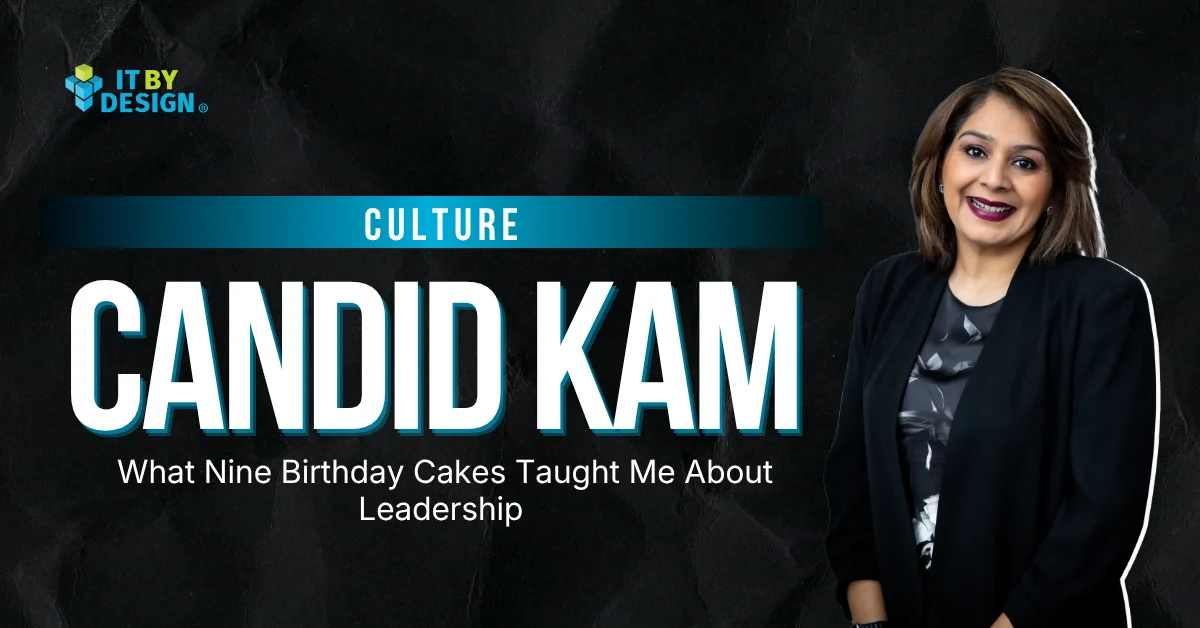
I had one of those moments last week that made me laugh out loud and then go completely quiet inside my own head. Nick, our Marketing Associate, had never heard of Kinko’s, and honestly, that tells us everything.
We’re getting ready for our upcoming event, and I was talking to Nick about printing the agendas. I told him, casually, not to stress about it. If we need to, we’ll just run them over to Kinko’s. No big deal, we still have five days. He looked at me and asked, completely sincerely, “What’s Kinko’s?”
I stopped. “You don’t know Kinko’s?” He shrugged and said, “It’s a digital world.” Nick is 23. Bright kid. Genuinely had no idea what I was talking about.
Now, I spent four years working at the Staples Copy Center to put myself through university, so a well-bound document with labeled tabs is practically a love language for me. (Rency still sets up a full printed travel folder every time I’m on the road with the team, and I will defend that habit to anyone.) I believe in printed materials. Research actually backs this up: when people write things down, they retain it better. It’s one of the reasons I always have workbooks at Build IT Live. I want people physically writing their notes, not just passively listening.
When the World Moves and You Don’t
But Nick’s question stuck with me, because it wasn’t really about Kinko’s.
It was about relevance. It was about what happens when the world moves and a company doesn’t move with it. Kodak built one of the most iconic brands in history and then held on so tightly to film that they missed the digital shift happening right in front of them. Blockbuster had every opportunity to become Netflix and famously passed on it, twice. These aren’t cautionary tales from a business school textbook. They’re real companies that real people built over decades, that a younger generation now only knows as punchlines.
The question I haven’t been able to shake since that conversation is this: what are we doing, right now, to make sure we don’t become the Kinko’s in someone else’s story? What are we doing to make sure the next generation of workers, clients, and customers knows who we are, understands what we offer, and sees us as relevant to their world?
The 23-Year-Old Is Not the Problem
Because here’s the thing. It’s easy to look at a 23-year-old who can’t write in cursive and roll your eyes a little. But that 23-year-old is your future employee, your future buyer, and eventually your future decision-maker. The handwriting might be rough, but they are fluent in tools and platforms that many of us are still learning. Dismissing them is exactly the kind of thinking that turns a thriving company into a nostalgic memory.
The nostalgia is real, and I’m allowed to feel it for a minute. But it can’t be a place we stay. Every business owner, every leader, every person managing a team right now needs to be asking hard questions about whether their products, their processes, and even their brand still connect with where the market actually is, not where it was when they built the thing.
Nick didn’t mean anything by it. He was just being honest. And sometimes that kind of innocent honesty is the most useful thing you can hear. Don’t wait for your own Kinko’s moment to ask whether your business is keeping pace. Ask it now, while you still have time to answer it well.