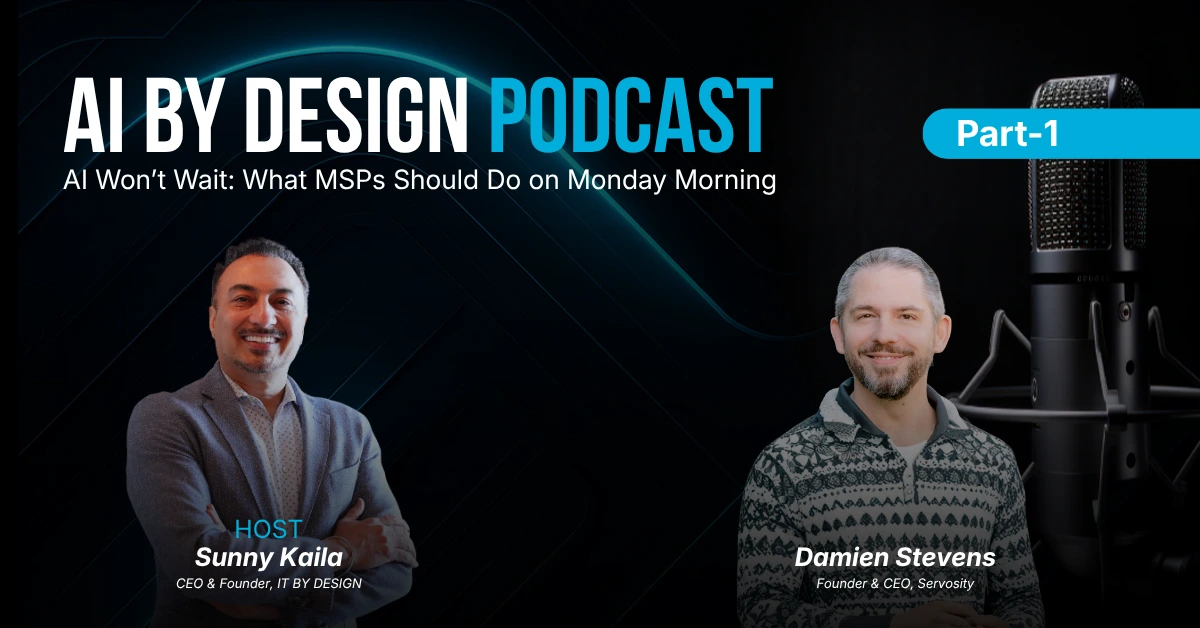
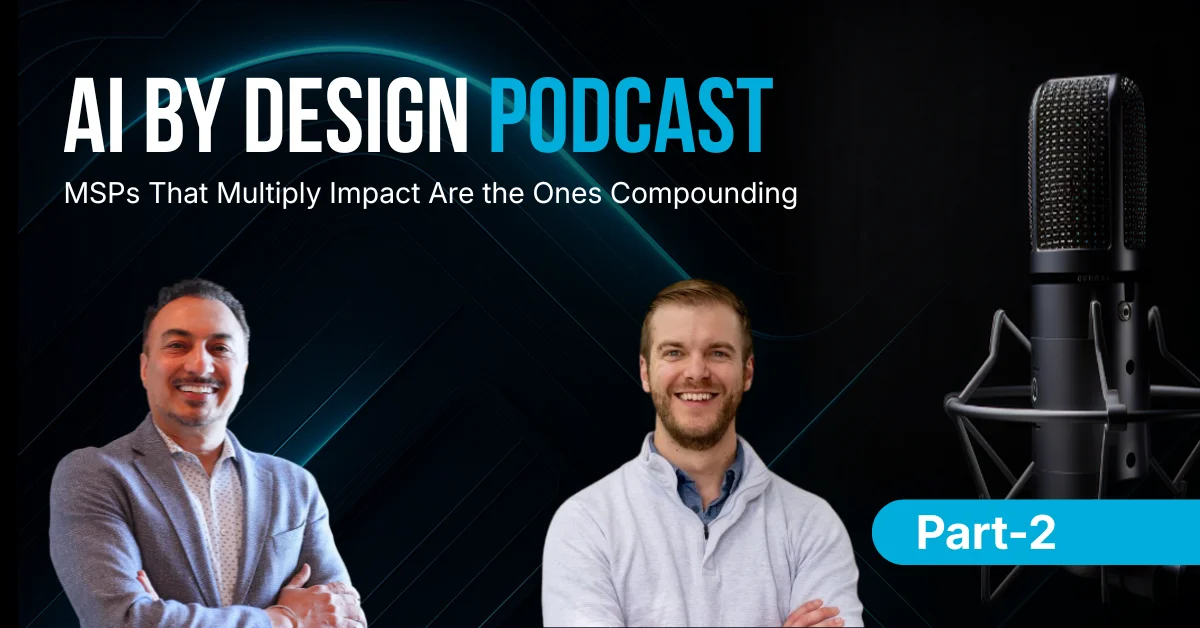
In Part 1 of this conversation, John Harden and I covered the foundational gaps holding MSPs back. Skipping the generative AI foundation. The friction framework. The shift from transactional to strategic partner. In Part 2 we went deeper. Into pricing models, real-world AI implementation, change management, and the one structural move every MSP leader needs to make right now.
From Activity to Outcome: The Pricing Conversation Nobody Has Answered Yet
The managed services pricing model has not fundamentally changed in years.
Per user. Per endpoint. Per device. Activity based. You manage the infrastructure and you charge accordingly.
John and I both agree that model is being challenged right now.
The shift is toward outcome-based pricing. Instead of charging for what you manage, you charge for the impact you create. Define the KPI for the business. Measure the before and the after. Charge based on the delta.
Here is a real example. A workflow that costs a client $100,000 annually without AI automation. After implementation that cost drops to $10,000. You saved them $90,000. A percentage of that saving becomes your fee.
Both parties win. The client captures the value. The MSP captures a share of the future they helped create.
But John was honest about where this gets complicated.
“My only aversion to outcome-based pricing is it makes sense till it doesn’t. What happens when an employee that came out of college can do that with a prompt in the future?”
His concern is real. The pace of AI means that what requires deep technical expertise today may not tomorrow. A managed service model built around iteration, keeping up with change, and continuous implementation may be more durable than purely chasing outcome deltas.
The answer is probably somewhere between both. And that is exactly the challenge MSPs are navigating right now.
The Revenue Leak Agent: A Real World Example
At IT By Design we have been wrestling with the same pricing question.
So, we built something called the Revenue Leak Agent.
Here is the problem it solves. In the MSP space a lot of true up happens at the end of the billing cycle. Technical people are great at solving technical problems. But they do not always see the business opportunity in front of them. A technician might spend 50 hours on a ticket that was never in scope for the managed services contract. That ticket should have been converted to a project. The revenue was there. It just leaked.
The Revenue Leak Agent finds those opportunities. It reviews billing, identifies out of scope work, and surfaces the true up automatically every month.
For clients over $10 million that kind of agent can recover $100,000 annually in previously lost revenue.
But pricing that agent is its own challenge. Do you scope it by engineering hours? Do you participate in the outcome it generates? That conversation is still evolving for us and for the industry.
What it proves is this. The MSPs who build agents that directly impact client revenue will have a much stronger case for outcome-based pricing than the ones deploying generic automation.
The Pace Is Different This Time
In our AI leadership workshop we open with a simple exercise. What changed in the last 90 days?
The last two sessions were exactly 90 days apart. January 13th to April 13th.
In that window ChatGPT went from 400 million users to 900 million. The cloud valuation moved from $30 billion to over $330 billion. Small business AI usage reached 82 percent. It was below 50 percent 90 days before.
This pace is unlike anything we have seen. It is larger and faster than the internet age.
Claude Cowork launched in February and changed how teams imagine working with AI tools entirely. Copilot adoption is accelerating.
The point is not the individual numbers. The point is the velocity. Every pricing model, every go to market strategy, every implementation approach has to be built with the assumption that it will need to change faster than anyone is comfortable with.
The Two Biggest AI Strategy Mistakes Leaders Are Making
I asked John directly. What is the blind spot? What are leaders getting wrong without realizing it?
He gave two answers.
The first. You cannot have an AI transformation with have-nots.
You can have rollout rings. You can phase your implementation. But you cannot tell an entire department they will never be part of the transformation. The data is clear. When employees are included in the change the adoption goes up and the value created goes up with it.
The second. Executive communication is being skipped.
John referenced a three to one finding. When an executive sponsor actively communicates the vision of AI transformation to the organization, employees adopt at three times the rate of any other intervention.
What is actually happening in employees’ heads right now is not complicated. They want to know if they are losing their job. They want to know what the goal is. They want to know where their training is coming from. They want to know what the strategy is.
“I could take any one of those tools, even if it is the wrong one for the business. If I do the change management right, they will get more value out of the wrong tool than they will get out of the right tool with no change management.”
That line stopped me. And it should stop every MSP leader reading this.
The tool debate is a distraction. Copilot versus Claude versus ChatGPT. It does not matter as much as most people think. The change management is what drives the outcome.
Reshaping Teamwork. Not Replacing People.
This is the message leaders need to carry into their organizations right now.
It is not AI replacing jobs. It is people with AI skills replacing people without them.
The framing matters. When leaders position AI as something happening to their team, resistance builds. When they position it as something happening for their team, the dynamic changes completely.
The language we use at IT By Design is simple. We are reshaping our teamwork. Not replacing our people. That message creates the psychological safety that makes adoption possible.
The One Action John Recommends Above Everything Else
If you could only do one thing to lead with AI rather than react to it, what would it be?
John’s answer was immediate.
Build your AI council.
Who is your executive sponsor? Who is your policy sponsor? Who is your budget sponsor?
Then build your AI executive committee. The stakeholders across the organization who will drive the change from the inside.
And do not just look at your leadership levels. Look downstream. The next generation workforce that has entered your team is already itching to help lead this. Give them the structure and they will run with it.
“Build the team that is going to run this implementation. Do not just use a tool.”
Everything starts with people. The who before the how. Get the who right and the how follows.
What This Means for MSPs Right Now
The MSPs who read this conversation and walk away with a single action should walk away with this.
Stop debating tools. Start building people.
Form your AI council. Name your executive sponsor. Include the whole organization in the change. Get in front of the fear before it becomes resistance.
Then build one agent that directly impacts a client’s revenue. Price it. Learn from it. Build the next one.
That is how you move from experiments to real AI impact.
And that is how the MSP relationship stops being transactional and becomes something worth keeping for the long term.