There is a moment in every major technology shift when the conversation stops being about whether and starts being about how.
We are in that moment right now with AI.
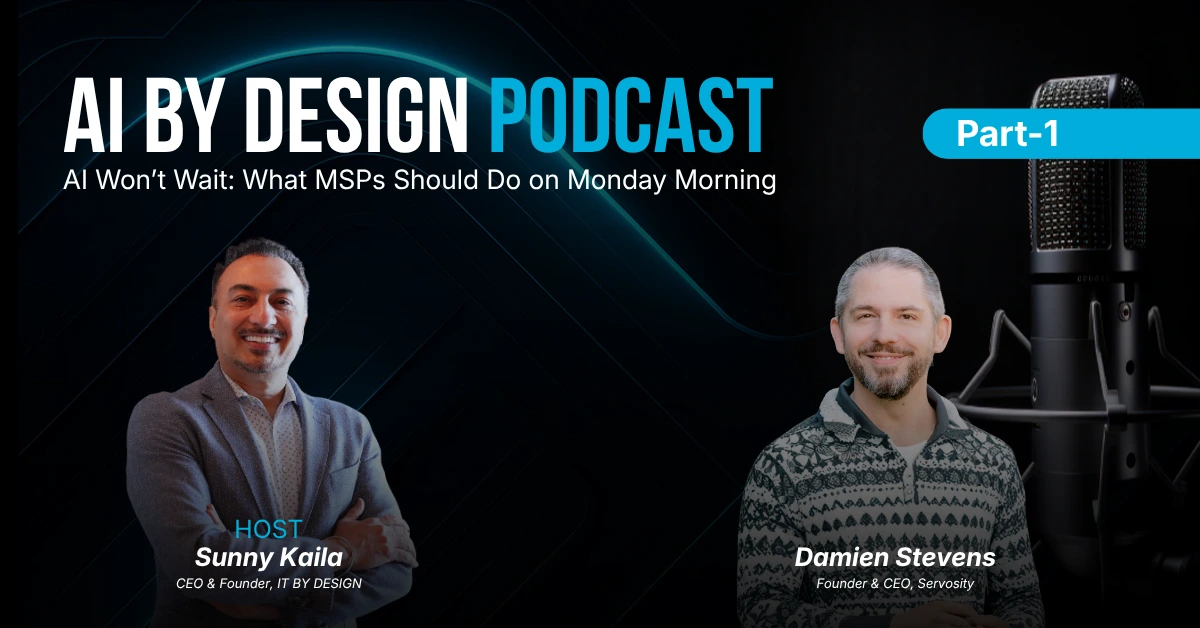
I have spent the last several months in rooms, on calls, and in deep working sessions with MSP leaders across every stage of growth. What I am hearing is no longer curiosity. It is urgency. Not panic. Urgency. The kind that comes from watching your competitors move while you are still planning.
The leaders pulling ahead are not the ones with the biggest budgets or the most technical staff. They are the ones who decided to become Customer Zero. They built inside their own business first. They learned what breaks, what scales, and what actually delivers value. And then they brought that knowledge to their clients.
That is the pattern. And it is compounding faster than most people realize.
AI Is a Skill. Not a Software.
One of the most important reframes I keep coming back to in these conversations is this.
AI is not a tool you buy. It is a skill you develop.
The fear that AI will take jobs is real but it is misdirected. AI will not replace the attorney, the engineer, or the technician. It will replace the attorney who refuses to develop AI skills. The ones who embrace it as leverage will take work from the ones who do not. That has always been how technology shifts play out.
What is different this time is the speed.
The professionals using AI as an unfair advantage are not waiting for permission. They are already operating at a different level. Faster analysis. Better decisions. More capacity. And the gap between them and everyone else is not closing. It is widening every single month.
For MSPs this creates both a responsibility and an opportunity. Your clients are trying to figure this out. Most of them do not know where to start. They know their competitors are moving. They feel the pressure. But without someone to guide them through the complexity, they either do nothing or they do the wrong thing.
That someone should be you.
The Career Opportunity Inside Your Own Team
Before MSPs can guide clients through AI transformation they have to transform internally.
One leader I spoke with recently reframed the entire conversation for their staff. This is not about losing jobs. It is about changing the job. Level one help desk technicians becoming AI engineers. Staff learning to identify automation opportunities inside client environments. The entire organization slowly shifting from being a help desk provider to being an intelligence provider.
That framing matters. When your team understands that AI is a career accelerator and not a threat, the internal adoption curve changes entirely. And the MSPs who are building that culture now are fast-tracking credentials like the Microsoft Frontier accreditation to back it up with real market positioning.
The internal transformation is not a side project. It is the prerequisite for everything else.
What Clients Are Actually Asking For
The questions I am hearing from clients right now are not what most people expect.
They are not asking which AI tool to buy. They are asking something much more specific.
How do I get visibility into parts of my business I have never been able to see before? How do I get systems that were never designed to talk to each other to share data in real time? How do I build something that works the way my business works instead of adapting my business to the way a piece of software works?
Those are operational questions. Strategic questions. And they require someone who understands both the technology and the business well enough to bridge them.
One MSP leader I spoke with recently said it better than I could.
“It is so much more powerful when you can get a system that works in your workflow versus trying to buy a piece of software off the shelf and adapting the way your company works to the way that software works.”
That is what good AI implementation actually feels like. Not a demo. A revelation. The moment a client realizes their business can run the way they always wanted it to run, everything changes.
The spectrum of who needs this is wider than most MSPs think. I am seeing it play out from small businesses automating a single workflow all the way to large retailers licensing their own open AI models internally for demand forecasting, inventory management, and sales statistics. The complexity differs. The core need does not. Every business wants systems that work the way they work.
The Quick Win That Changes Everything
There is a pattern I have seen repeated across dozens of conversations.
When an MSP helps a client get one quick win with AI, something shifts in that client’s thinking. They stop asking whether AI is worth it. They start asking where else it can go.
A founder in one of our recent sessions put it simply.
“Once you successfully help them put in one small automation or one quick win, their mind starts to go. Well, what if we do this in this part of our business? What if we do this here? And the answer is almost always yes.”
One integration. One automation. One workflow that used to require four people and now runs itself. That is the moment the relationship changes. The client stops seeing their MSP as a vendor and starts seeing them as a strategic partner.
The framing that resonates most with clients right now is not about saving a little time. It is about return on investment that is felt immediately. Not incremental improvement but transformation that pays back five times over out of the gate. When you frame AI implementations around that level of impact the conversation changes entirely.
But not everything should be automated. That is an equally important lesson.
Saving three hours a month across one person is not worth the build. Saving four hours a week across six people is a different conversation entirely. The discipline to say no to the wrong automations is what makes you credible when you say yes to the right ones.
Governance Is Not Optional
One of the most important conversations happening inside MSPs right now is about data security and governance around AI tools.
The platforms that are gaining the most trust with clients are the ones designed from the ground up to keep data internalized and compartmentalized. Models that do not train on client data. Systems that give MSPs the ability to guide prompt writing, build workflows, and restrict which LLMs are accessible depending on the sensitivity of the work being done.
That level of intentionality around data governance is what separates a responsible AI deployment from a liability waiting to happen.
Shadow AI is already inside your clients’ businesses. People are using tools that were never approved, never secured, and never documented. When something goes wrong the MSP is still expected to fix it.
Getting ahead of that with acceptable use policies, data governance frameworks, and structured AI onboarding is not optional anymore. It is the foundation everything else is built on.
The Shift Nobody Is Talking About Enough
Here is what I believe is the most undervalued conversation in the MSP space right now.
Every automation you build becomes a dependency. Every dependency requires maintenance. And maintenance is a recurring managed service that most MSPs have not priced yet.
We shifted from managing servers to managing cloud workloads. The next shift is managing AI workloads. Token exhaustion. LLM downtime. API dependencies. Change control for automated workflows. These are infrastructure concerns and they need to be treated like infrastructure.
The MSPs who are ahead of this conversation are not just building automations for clients. They are building the governance frameworks, the change control processes, and the maintenance contracts that keep those automations running. That is where the recurring revenue lives. That is where the enterprise value is built.
What Separates the MSPs Who Win
I have had this conversation enough times now to see the pattern clearly.
The MSPs who are winning with AI are not the ones with the most sophisticated technology. They are the ones who started internally. Who became Customer Zero before they tried to be the guide. Who built something real inside their own operations, learned what actually works, and then brought that earned credibility to their clients.
They are curious. They are experimenting. They are documenting what they learn. And they are bringing their clients along at the right pace rather than overwhelming them with possibility before the foundation is in place.
The ones falling behind are still waiting for the perfect plan. Still running pilots that never convert into production. Still asking whether AI is really ready for their business.
It is ready. The question is whether you are.
The window to be the guide is open. The MSPs who step into that role now will not just survive the AI era. They will define what managed services looks like on the other side of it.
And that is a position worth building toward.