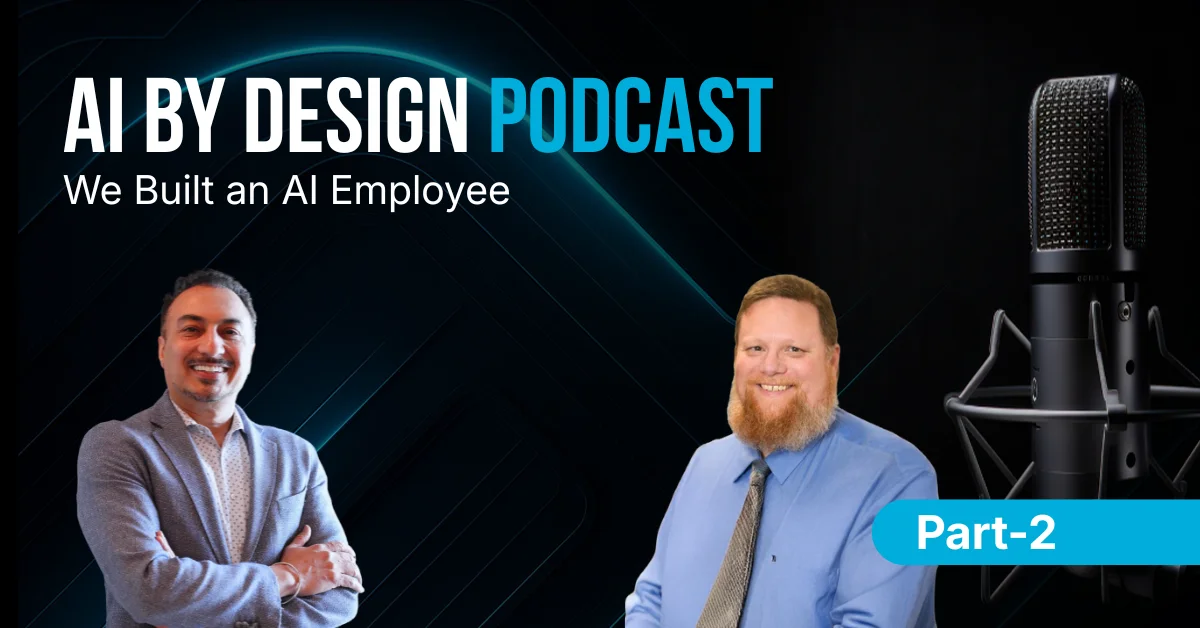
Part 2 of my conversation with Keith Schoolcraft
There is a moment in every technology shift when it stops being theoretical.
It stops being something you read about in a newsletter or watch someone else demo on stage. It becomes something you are doing. Quietly. Consistently. In the middle of a Tuesday afternoon, in a hotel room, listening to a podcast-style recap of a meeting you missed, generated by AI.
That moment already happened.
And Keith Schoolcraft, Founder of A Couple of Gurus, is living proof that the MSPs paying attention right now are not just staying competitive. They are building something the rest of the market hasn’t caught up to yet.
The Meeting Recap That Became a Podcast
Let me start with the detail that I think says the most.
Keith was traveling. He missed an internal engineering meeting. He knew it had been recorded. He pulled up Microsoft Copilot, found the summary and then noticed something he hadn’t seen before. A replay button. In podcast format.
Two voices. News-anchor style. A crisp seven-minute synopsis of everything that happened, who said what, what was decided, and why it mattered.
“I actually listened to the whole thing,” Keith told me. “It was entertaining. I was like, wow.”
That’s the shift right there.
Not AI as a concept. Not a vendor pitch. A real professional, in a real moment, discovering that the tool already in his stack could deliver information in a format so compelling he chose to consume it over anything else.
For MSPs, this is the insight: Your customers are not waiting for AI to be ready. They are discovering it in real-time. The question is whether you are the one guiding that discovery or whether they are doing it alone.
AI Is Already Sitting in the Interview Room
The other thing Keith shared that stopped me mid-conversation was this: LinkedIn’s AI candidate screening.
When you post a paid job on LinkedIn, you can now opt in to have an AI conduct the initial screening interview. It asks your customized questions. It has a real conversation with candidates. It lets hiring managers move through far more applicants without playing phone tag or loading up a recruiter’s calendar with 30-minute calls.
“You just get through a lot more candidates a lot faster,” Keith said. “And you don’t have to worry about how you’re going to contact this person.”
We are building something similar inside TeamGPS for our clients – an outbound AI voice agent that calls candidates directly, runs through a telephone screening checklist, handles FAQs the way a trained recruiter would, and passes qualified candidates up the chain. Same logic. Same outcome. Recruiters focused on high-payoff activities. AI handling the volume.
The MSP opportunity here is significant. Businesses that are hiring are already being interrupted by this problem. If you can walk into that conversation with a solution: whether it is LinkedIn’s built-in tool or a custom-built agent, you are not selling technology. You are solving a very real, very urgent pain point.
Explore how IT By Design’s AI offerings help MSPs bring exactly that kind of solution to their clients
Meet the Robot Employee Who Handles Your Onboarding
Here is where Keith’s story gets genuinely interesting from an automation architecture standpoint.
His team uses a platform called Process Plan to manage multi-department workflows – specifically new customer onboarding, which touches sales, admin, and engineering in sequence. Six or seven months ago, Process Plan released an AI robot feature. Keith’s team took a screen recording of their process and handed it over.
What came out the other side is something worth paying attention to.
They created an AI robot user. With an email address. With a licensed login to their ConnectWise system. This robot receives the handoff at a specific point in the sales workflow, creates the client account in ConnectWise, sets up the contact, and builds out the full SharePoint folder structure the company uses for every new client.
Here’s the detail that matters most from a security standpoint: the robot goes to its own email inbox to retrieve its two-factor authentication code before logging into ConnectWise.
“He’s adhering to proper security,” Keith said.
It then hands the workflow back to a human salesperson when its part is complete. Fifteen to twenty minutes of consistent, repetitive administrative work gone.
This is process automation done right. Not AI replacing people. AI handling the parts of the process that don’t require judgment, so the humans in the chain can focus on the parts that do.
The Warning That Most People Skip Over
Now here is the part of the conversation that I think is most undervalued. And Keith raised it himself.
“The more you automate, the more you have to make sure you’re staying on top and managing the automations.”
Every time you change your underlying process, you have to update the robot. Change a folder structure in SharePoint. Update a step in ConnectWise. Adjust your onboarding checklist. Any of those changes can break the automation if the update doesn’t follow.
I made the comparison to Excel: one linked sheet changes, and something three steps downstream breaks silently. Keith agreed immediately.
This is where MSPs need to be positioning themselves right now.
Businesses are building automations. They are building AI agents. They are creating digital workflows that are increasingly load-bearing for the way their business operates. And just like cloud infrastructure, just like physical servers before that, those systems require management, maintenance, and expertise to keep running.
This is not a threat to the MSP model. It is an extension of it.
The companies that are ahead of this conversation: the ones helping clients build with change-control frameworks, dependency documentation, and scheduled review cycles built in, will be the ones that turn AI adoption into a recurring managed service.
Token Exhaustion and the Infrastructure Problem Nobody Is Talking About Yet
Keith raised something toward the end of our conversation that I have not heard discussed enough in the MSP space.
Token exhaustion.
Right now, most businesses are testing AI tools individually. A Copilot subscription here. A Claude API hook there. The token limits feel like a free-tier inconvenience. But as businesses start to deploy AI into actual business-critical workflows and as those AI users start making API calls at scale: token exhaustion becomes a real operational risk.
“What you don’t want is all of a sudden an AI robot is running into a critical process and he runs out of tokens,” Keith said.
We are not there yet for most businesses. But MSPs who are thinking ahead are already asking the question: How do we design these AI and automation solutions so they are resilient? How do we architect for efficiency, not just for capability? How do we ensure that an AI agent running out of tokens does not stop a new customer onboarding from completing?
The parallel to cloud architecture is direct. We shifted from managing servers to managing cloud workloads. The next shift is managing AI workloads. The MSPs who develop that expertise now will own a category that does not exist yet at scale but will.
The Business Model That Emerges from All of This
Let me bring this together with something practical.
Keith’s company, A Couple of Gurus, has structured an AI Enablement Initiative specifically for this moment. And what makes it different from most AI offerings in the market is this: they do not require you to be a managed services customer to engage.
The entry point is a conversation. How is your workflow structured today? Where are the inefficiencies? What are the opportunities? They stand in the gap between where AI technology is moving and what the customer knows how to do with it.
That is the value proposition that resonates right now.
Not: Here is a new tool you should buy.
But: Here is how your business can operate better and here is someone who will help you get there.
What MSPs Should Be Taking Away from This
If you read through this and you are thinking about your own practice, here is where I would focus.
Governance first. Shadow AI is already in your customers’ environments. People are using tools that were never approved and never secured. Get ahead of that with acceptable use policies and user education before you are cleaning up after something that went wrong.
Automate the repeatable. Your customers have administrative processes that touch multiple departments and require no judgment. Those are the first targets. Onboarding. Offboarding. Client folder creation. Recurring reporting. Find them and build.
Sell the maintenance, not just the build. Every automation you help a customer deploy becomes a managed dependency. Change control, monitoring, and ongoing maintenance are natural recurring service lines. Price accordingly.
Design for resilience. As AI becomes operational, not experimental, reliability matters. Token limits, LLM downtime, API dependencies: these are infrastructure concerns. Treat them like infrastructure.
Start the conversation now. The businesses that figure this out first will not be waiting for their MSP to bring it to them. Your window to be the guide is open. Use it.
Keith said something near the end of our conversation that I keep coming back to.
“I think the next iteration is shifting to managing the AI workloads and the AI design.”
That is not a prediction about a distant future. That is a description of what is already starting to happen.
The MSPs who are building toward that – the ones who are curious, experimenting, documenting, and bringing their customers along – are not just surviving the AI era.
They are writing the playbook for what comes next.
Want to connect with Keith Schoolcraft? Reach him at keith@acoupleof gurus.com
If your MSP is thinking about AI assessments, enablement programs, or building AI-assisted workflows for clients, this is the conversation to be having right now.