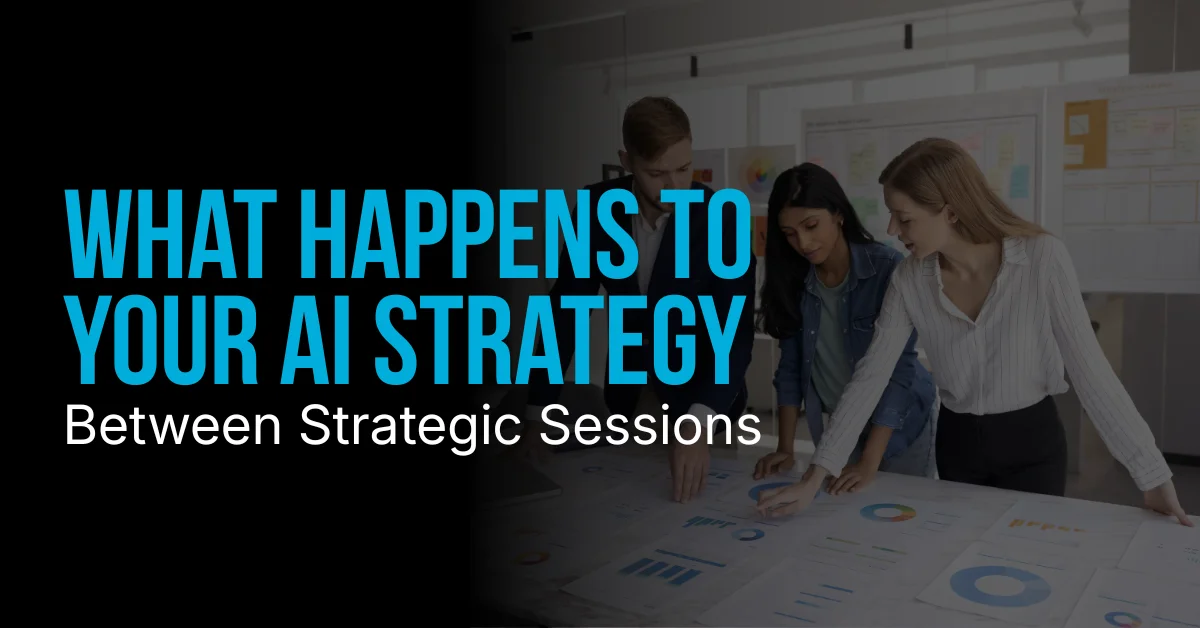
MSP AI strategy accountability is the structured practice of maintaining, pressure-testing, and calibrating AI decisions between major planning moments. Most MSP leaders make solid AI decisions at events or offsites, then watch those decisions quietly dissolve under daily operational pressure. The gap between decisions is where strategy drift happens, and without a peer-level accountability environment, even the right decisions lose momentum before they produce results.
Why AI Strategy Drift Happens to MSP Leaders Who Made the Right Decision
You did not make a bad decision. That is the part most MSP leaders get wrong when they look back at a strategy that stopped moving.
MSP AI strategy accountability is not about making better decisions at the event. It is about what happens to those decisions when Monday arrives and the tickets are stacking up. The drift is not personal. It is structural.
Here is the sequence that plays out in almost every MSP:
- A leader leaves an event or planning session with real clarity and a solid direction
- Within two to three weeks, daily operational urgency quietly takes over
- Nobody announces a strategy change. The strategy just stops being executed
Why Does Event Energy Fail to Survive Daily Operations?
Events are high-clarity environments. The noise is filtered out, the thinking is focused, and the direction feels obvious. Daily operations are the opposite. The moment a leader re-enters their business, urgency competes directly with strategic intention and urgency wins unless there is a structure protecting the strategy from that competition.
How Does Operational Urgency Override Strategic Intention?
MSP businesses run on response. Tickets, SLAs, and client escalations are immediate and measurable. Strategic AI decisions are deferred and invisible. When the two compete for the same leadership attention, the immediate always wins. The leaders who execute on AI strategy are not less busy. They have a maintenance environment that keeps the strategy alive between the big moments.
Why the Gap Between Decisions Is the Most Dangerous Place in MSP Leadership
Most MSP leaders pay close attention to their big decisions. What they do not watch is the silence between those moments. That silence is where MSP leadership decision making actually gets set, without intention, without announcement, and without anyone noticing until the damage is done.
Strategy drift is the gradual departure from a decided direction that occurs when MSP leaders have no structured accountability environment between major decisions. Not because the decision was wrong. Because execution has no ongoing calibration mechanism.
Why Do Operational Decisions Fill the Vacuum When Strategy Goes Unchecked?
When strategic direction is not actively maintained, operational decisions fill the space. A hiring call gets made based on immediate capacity pressure rather than AI workforce strategy. A client conversation gets handled reactively rather than through the lens of the AI roadmap. None of these feel like strategy changes in the moment. Over six months, they add up to a completely different direction than the one the leader originally decided on.
What Does it Cost an MSP When Six Months of Drift Goes Undetected?
The cost is quiet, not dramatic. Margin does not collapse overnight. What happens instead is that the leader arrives at the next planning session and realizes the gap between where they intended to be and where they actually are is larger than expected. The next session becomes about recovery rather than progression.
Why Accountability Without Peer Context Fails MSP Leaders
Most MSP leaders already know they need accountability. Many have tried to build it. It did not hold, not because of lack of discipline, but because the accountability source did not have the right context.
To understand what execution looks like when the strategy actually holds, the source of accountability matters as much as the structure itself.
Why Can’t Internal Teams Provide the Challenge MSP Owners Actually Need?
Your leadership team executes the direction you set. They are not positioned to challenge it without professional risk. The dynamic prevents the honest pressure-testing that high-stakes AI decisions require. This is not a leadership failure. It is a structural limitation.
How Does Vendor Accountability Create the Illusion of Strategic Alignment?
Vendors are invested in your success, but their definition of success runs through their product. When a vendor validates your AI strategy, they are confirming it through the lens of what they sell. That is filtered feedback dressed up as strategic guidance, not genuine peer challenge.
What Makes Generic Mastermind Groups Ineffective for MSP Operators?
Most mastermind groups fail MSP operators for one reason: composition. Participants do not share the same operational context, business model, or decision stakes. The conversations are supportive rather than challenging, which confirms decisions instead of stress-testing them. That is the opposite of what a drifting strategy needs.
Why MSP Leaders Who Stay Calibrated Between Decisions Outperform Those Who Only Show Up at Events
The performance gap between MSP leaders who calibrate continuously and those who calibrate only at events is not about intelligence or resources. It is about compounding.
Every decision that gets pressure-tested and maintained in a structured peer environment builds on the last one. Every decision that drifts unchecked resets the clock. Over twelve months, that gap becomes visible in margin, service quality, and AI execution maturity.
Why Does Event-Only Calibration Create a Quarterly Reset Pattern?
Event-only calibration feels productive because the clarity is real. But if that clarity has no structure to survive the weeks that follow, the next event becomes a reset rather than a progression. The leader leaves inspired, drifts, and arrives at the next event roughly where they started. This is a pattern, not a personal failure, and it is entirely predictable once you see the mechanism.
What Does 12 Months of Continuous Calibration Look Like Versus 12 Months of Drift?
Operators who maintain ongoing peer calibration compound their decisions, with each one building on the last. Operators who calibrate only at events rebuild from scratch each quarter. The difference is not visible after one cycle. It becomes undeniable after four.
Why a Structured Peer Environment Closes the Gap That Nothing Else Can
The answer is not another framework, another tool, or another event. MSP peer accountability at the operator level requires a specific environment: peers who share the same operational stakes, no reporting relationship, no product agenda, and a cadence that matches the pace of AI decision-making in 2026.
What Makes Peer Composition the Critical Variable?
The right peers are not just other business owners. They are operators who understand what it costs to run an MSP, what it means to make an AI hiring decision, and what the real trade-offs look like at the service delivery level. That shared context is what makes the challenge credible and the calibration useful.
Why Does Cadence Matter as Much as Content?
Monthly calibration is the minimum effective frequency for MSP leaders navigating AI adoption right now. Quarterly is too slow. The landscape moves faster than that, and so does drift. The goal is not a scheduled check-in. It is a recurring environment where drift gets caught before it compounds.
Conclusion: The Gap is Real. So is the Fix.
Strategy drift is not a character flaw. It is a predictable outcome of making high-stakes decisions in high-clarity environments and returning to an operation with no structure to keep those decisions alive.
The MSP leaders compounding their AI advantage right now are not operating at a different intellectual level. They are operating inside a different environment, one where decisions get pressure-tested by peers who understand the stakes and maintained on a cadence that matches the pace of change.
If the gap between your intentions and your execution feels familiar, the AI Mastermind peer group session on August 2, 2026, in Jersey City , NJ is worth your attention. It is a structured, operator-level environment built for MSP leaders who are ready to keep their AI strategy honest between decisions, not just at the next event.
FAQ: MSP AI Strategy and Peer Accountability
Q1: Is it normal to feel like my AI strategy loses momentum after every event or planning session?
Completely normal and entirely predictable. Without a structured accountability environment, AI decisions made at events have no mechanism to survive daily operational pressure.
Q2: How do I know if my AI strategy is drifting or just evolving naturally?
Evolution is intentional and named; drift is reactive and unannounced. If you cannot trace your current AI direction back to a deliberate decision you maintained, it has likely drifted.
Q3: Why doesn’t my leadership team provide the accountability I need for AI strategy?
Your team executes direction and is not positioned to challenge it without professional risk. That kind of pressure-testing requires peers with no reporting relationship and real operational context.
Q4: I have tried mastermind groups before and they did not work. What makes an AI peer group different?
Composition. Most mastermind groups fail MSP operators because participants do not share the same operational stakes. An MSP-specific AI peer group runs on operator-to-operator challenge, not facilitated win-sharing.
Q5: How often does a peer calibration environment need to meet to prevent strategy drift?
Monthly is the minimum effective frequency in 2026. Quarterly is too slow and drift compounds faster than most leaders expect between sessions.
Q6: What are the signs that my current AI strategy is still on track?
Three signals: the original decision is still being executed, your team can articulate the direction unprompted, and new operational decisions align with the strategy rather than work around it.