AI for MSPs: Why Mindset Will Define the Winners (Part 1)
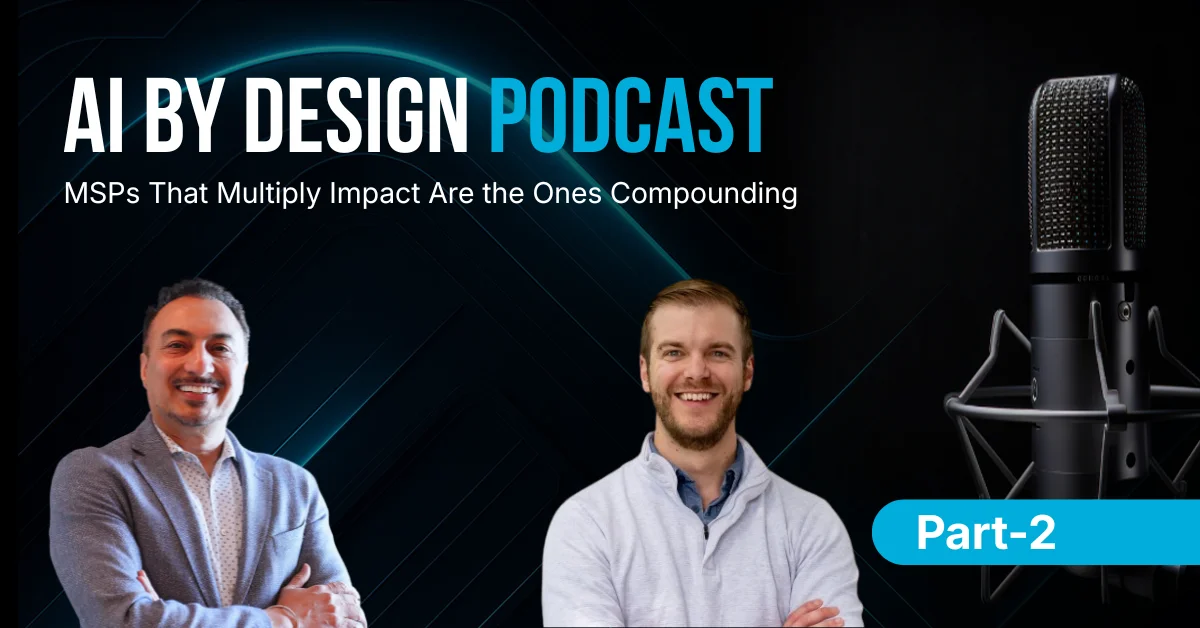
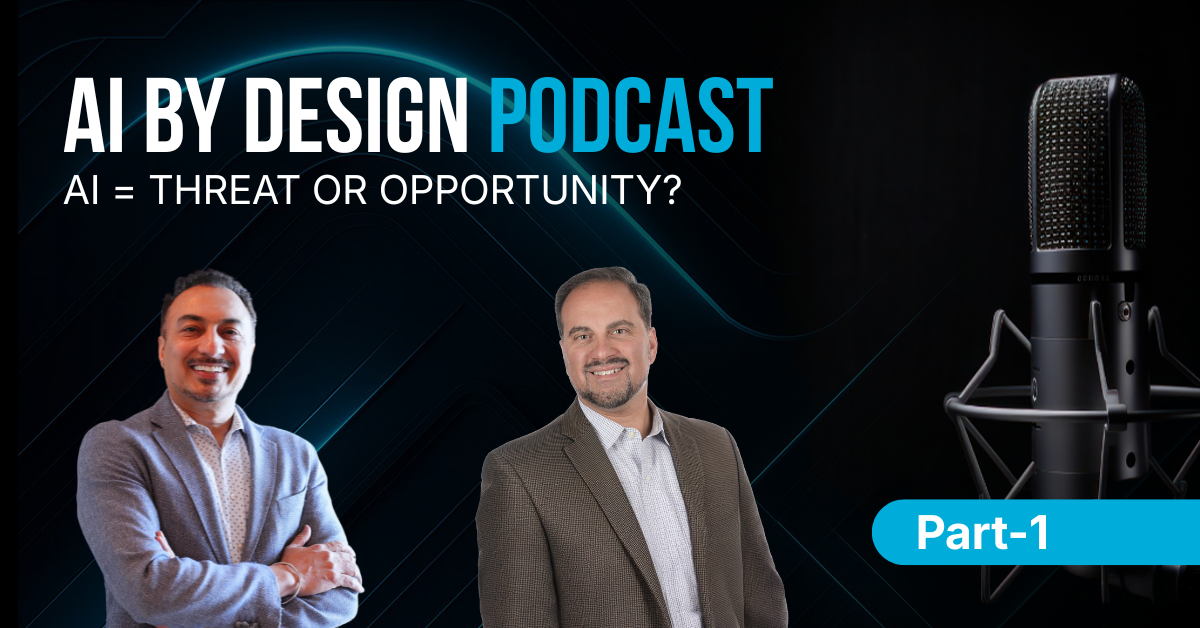
In this first part of my conversation on AI By Design, Ed Cordiano and I focused on the foundation behind everything else: the entrepreneurial journey, the power of community, and how AI is starting to reshape MSP service delivery, customer expectations, and business responsibility.
This conversation was exactly what I want this series to be:
Real.
Honest.
Useful.
My promise with AI By Design is simple: I want these episodes to feel authentic.
I want us to talk about what we know, what we are learning, and even the mistakes we have made along the way, so others do not have to pay the same tuition fee.
That is the spirit in which Ed and I started this conversation, and it set the tone for everything that followed.
Why I Wanted to Start with the Human Side of the Journey
Before we got into AI, I wanted Ed to talk about something many people need to hear more of: the real entrepreneurial journey.
Too often, people see the outcome and not the path.
They see the business.
They see the brand.
They see the success.
What they do not always see is the uncertainty, the leap, the risk, and the moments when you have to keep going before anything feels stable.
That is why I asked Ed to start there.
And what he shared felt deeply relatable.
How Ed Cordiano Built His MSP Journey
Ed shared that his entrepreneurial path began after coming out of engineering school and spending time in corporate America. Like many people, he had a steady path in front of him. But he also had something else: a burning desire to build.
That inner pull eventually became strong enough that, with the support of his wife, he made the decision to step into entrepreneurship nearly a decade ago.
He and his family explored different options for what they wanted to build, and after a lot of searching, they decided that building an MSP was the right road. That led them into CMIT Solutions in the Cleveland area, where they began creating their future in the managed services space.
Then, a few years into that journey, COVID hit.
And that changed everything.
What Entrepreneurship Really Looks Like When the Unexpected Happens
One of the most honest parts of the conversation was when Ed talked about COVID.
You can build financial models.
You can think through scenarios.
You can prepare as best as you can.
But a global pandemic is not something most entrepreneurs put on the spreadsheet.
That part of the conversation mattered because it captured something true about entrepreneurship.
You cannot predict every disruption. You cannot script the market. But you can adapt. You can shift. You can keep moving.
That is exactly what Ed and his team did.
And I think that deserves recognition.
There are all kinds of statistics about how few businesses make it through the early years. So, when I talk to an entrepreneur who has stayed in the game for nearly a decade, I see that as something meaningful.
It is not luck. It is resilience, commitment, and the willingness to keep solving problems when conditions change.
Why Community Matters More in Difficult Times
Another important part of this first conversation was the role of community.
When we talked about COVID and uncertainty, it became clear that one of the biggest advantages Ed had was not just business knowledge.
It was being surrounded by the right people.
Within the CMIT ecosystem, there was collaboration. There were other thinkers. There were people sharing experience, perspective, and support. Ed was clear that this kind of network was incredibly helpful.
I agree with that completely.
In hard seasons, mindset matters.
Community matters.
Who you are surrounded by matters.
When uncertainty rises, isolation becomes expensive.
The right room can help you stay positive, stay productive, and stay present. That was true during COVID, and I believe it is just as true now in the AI era.
Why AI Feels Like Another Defining Moment for MSPs
From there, we shifted into what many leaders are feeling right now.
AI has created another moment of uncertainty.
I talk to a lot of entrepreneurs and technology professionals, and I hear the same themes over and over again. There is doubt. There is fear. There is confusion.
But there is also a lot of opportunity.
So, I asked Ed directly how he was thinking about this AI era and what he believed it meant for MSPs and their customers.
His answer was balanced and practical.
He described it as challenging and exciting at the same time. He also called it the wild, wild west, which I think is exactly how many people feel right now.
There is a lot happening.
There are a lot of tools.
There is a lot of noise.
And in the middle of all that, businesses are looking for help.
How AI Is Changing the Role of MSPs
One of the strongest parts of the conversation was Ed’s view that MSPs now have an opportunity to create guardrails for the market.
That is such an important point.
AI is moving fast, but most SMB leaders are not looking for noise. They are looking for clarity. They are looking for someone who can help them understand where things are going, how to use AI responsibly, and what it means for their business.
Ed highlighted three major shifts happening right now:
1. Speed to resolution
As AI becomes more embedded into support operations, businesses will expect faster outcomes. Response time and resolution time will matter even more.
2. A more consultative MSP model
MSPs have always had a consultative side, but now that role becomes even more important. Customers are looking to their technology partners to help them make sense of change.
3. Security in an AI-driven world
This is one of the biggest issues. As businesses experiment with AI tools, the question is no longer whether teams are using AI. The question is whether they are using it safely and intentionally.
How AI Will Change MSP Service Delivery
I asked Ed to go deeper on service delivery and client expectations, and his answer got very practical.
He broke the work of an MSP team into two categories:
- direct client-facing support
- indirect background work
That indirect work includes things like:
- checking backups
- verifying endpoints are connected
- confirming systems are protected
- monitoring routine health and status issues
Historically, technicians had to handle much of that manually.
Ed’s view is that AI will increasingly take those indirect tasks off their plates. It can monitor, automate, alert, and in many cases eventually resolve issues in the background.
That matters for two reasons.
First, clients get access to technical help faster because technicians are spending more time on real client issues.
Second, MSP teams become more efficient because their people are focused where human expertise creates the most value.
This is one of the clearest examples of where AI can improve MSP operations without reducing the importance of people.
Why I Believe MSPs Have a Real Opportunity to Become Builders
This is where I felt especially aligned in the conversation.
I shared that across the market, I am seeing CEOs at every level ask the same questions:
What does AI mean for my business?
What does it mean for my team?
What does it mean for my outcomes?
What should my roadmap look like?
And who are they asking?
Their technology partners.
Their solution providers.
Their MSPs.
That is why I believe MSPs have a real opportunity right now to become builders, not just responders.
The market is looking for experts who can help build AI into business operations. Not in a vague way. In a practical, outcome-driven way.
That is a major shift.
Why AI Should Be Used to Multiply Human Impact, Not Remove It
Another important moment in the conversation was around jobs.
There is a lot of talk right now about AI replacing people. Ed pushed back on that, and I do too.
He made the point that if MSP leaders only see AI to reduce staff, they are looking at it the wrong way.
The better way to think about it is this:
AI can help an entry-level technician grow faster.
AI can help people reach higher-value work sooner.
AI can help teams maximize their potential in less time.
That is not replacement. That is augmentation.
And I think that distinction is critical.
The opportunity here is not to eliminate the seat. The opportunity is to empower the seat.
When people are equipped with AI thinking and AI tools, they can create more value, solve better problems, and multiply their contribution. That is how impact grows. That is how businesses grow.
What MSPs Are Seeing Across Their Customer Base Right Now
Ed also shared something that reflects the reality many MSPs are facing.
AI adoption across customers is not consistent.
In some companies, only a few employees are using tools like ChatGPT informally. In others, maybe one division is experimenting. In larger organizations, there may be growing curiosity without a clear plan.
In other words, the market is uneven.
That is important because it means MSPs cannot assume maturity. They have to meet customers where they are.
Some need awareness.
Some need policy.
Some need strategy.
Some need implementation help.
This is exactly why the consultative role becomes more valuable.
Why AI Security and Governance Need to Start Now
This may have been the most important practical learning from the first part of the conversation.
Ed made a strong point that security in the AI era is going to require a major shift. He compared it to the leap the market went through with EDR and MDR several years ago but suggested that the AI shift may be even bigger.
That is a serious statement, and I think he is right.
Businesses need to ask:
- What information are employees putting into AI tools?
- What guardrails are in place to protect company data?
- Do we have an acceptable use policy for AI?
- Are we standardizing on approved tools?
- Are we using paid company-controlled versions with user credentials?
- Are we restricting sensitive information such as PHI?
What stood out to me is that Ed did not frame this only as a technology issue. He framed it as an operational starting point.
For many businesses, the first step is not an advanced AI deployment. The first step is policy, language, and responsible use.
That is a very practical takeaway for MSPs.
What I Took Away from This First Part of the Conversation
What stayed with me most after this conversation was not just Ed’s perspective on AI. It was the way he connected entrepreneurship, adaptability, community, and business responsibility into one coherent mindset.
That mindset matters.
Because AI is not just another tool discussion. It is a leadership discussion.
The MSPs that grow in this era will not be the ones who panic. They will not be the ones who wait for perfect clarity. They will be the ones who help customers move forward responsibly, confidently, and strategically.
Key Takeaways for MSPs from Part 1
1. The entrepreneurial mindset still matters in the AI era
The same traits that help you survive hard business seasons also help you navigate AI. Adaptability, resilience, and willingness to learn still matter.
2. Community is a competitive advantage
Whether the disruption is COVID or AI, being surrounded by the right people helps you move faster and think better.
3. AI is changing what customers expect from MSPs
Clients do not just want technical support. They want a thought partner who can help them understand what AI means for their business.
4. MSPs have an opportunity to become builders
Businesses are actively looking for technology partners who can help them make sense of AI and build practical solutions around it.
5. AI can improve service delivery by removing indirect work
Background tasks like monitoring, checking, and routine verification can increasingly be automated, allowing technicians to spend more time on high-value support.
6. AI should augment people, not replace them
The best MSPs will use AI to elevate their teams, accelerate capability, and increase value creation.
7. Security and governance need to come first
Acceptable use policies, approved tools, access controls, and clear rules around sensitive data are no longer optional. They are becoming foundational.
8. Customers are at very different stages of AI adoption
Some are experimenting casually. Some are exploring more seriously. MSPs need to guide each customer based on where they are today.
Closing Thoughts
This first part of my conversation with Ed Cordiano reminded me that the AI opportunity in the MSP space is not just about tools.
It is about leadership.
It is about trust.
It is about helping customers move through uncertaianty with more clarity.
And it is about doing that in a way that is real, grounded, and responsible.
That is exactly why I wanted this conversation on AI By Design.
Because when leaders share what they have learned honestly, the entire ecosystem gets stronger.
This was Part 1 of the conversation.
In the next part, we get into what customers are asking MSPs today, especially around AI training, tools like Copilot, and how to approach security, governance, and AI adoption.
Stay tuned for more.