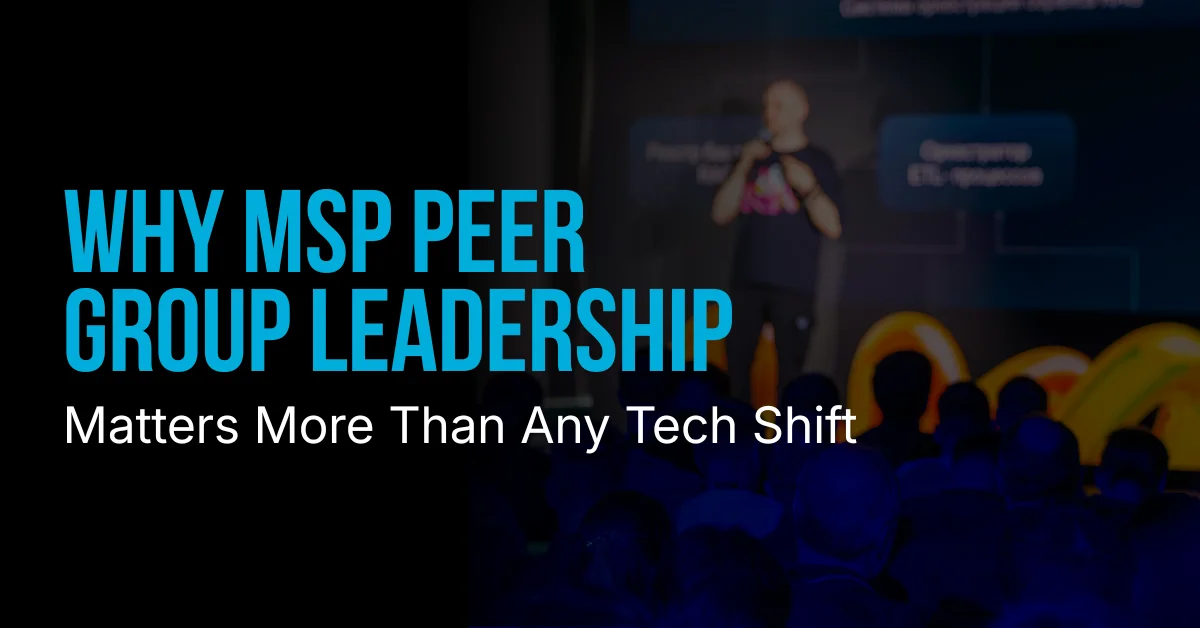
MSP peer group leadership refers to structured executive environments where MSP owners and operators sharpen decision quality alongside peers who understand the same operational pressures. Unlike general business coaching or vendor-sponsored events, these groups exist specifically to stress-test strategy, challenge assumptions, and build the kind of leadership clarity that no technology tool can provide. The room sharpens how you think and that outlasts every market cycle.
The Tech Will Change. The Leadership Challenge Won’t.
Every few years, a new topic takes over every MSP conference, LinkedIn feed, and vendor webinar. Right now, that topic is AI.
Before AI, it was automation. Before that, cloud migration. Before that, cybersecurity as a revenue line. Each wave arrived with urgency, vendor playbooks, and a crowd of early adopters who moved fast and a larger crowd who second-guessed themselves and moved late.
Here is the part nobody talks about enough: the leaders who navigated each of those waves well were not just better at picking tools. They were better at thinking through decisions under pressure. That is a leadership skill, not a technology skill.
And MSP peer group leadership is one of the few environments where that skill gets built.
Section 1: Every Leadership Era Has a “Big Topic”
Think back across the last decade of managed services. Each era had its defining pressure point.
- 2013–2016: Security as a service line. RMM and PSA consolidation.
- 2016–2019: Cloud migration. Azure/AWS competency pressure.
- 2019–2022: Automation, stack rationalization, MSSP pivots.
- 2022–present: AI integration, workflow redesign, competitive positioning.
The specific topic shifts. The underlying leadership challenge does not: How do you make sound strategic decisions when you have incomplete information, real operational constraints, and no clear consensus on the right move?
That is not a technology problem. It never was.
The reason leadership conversations keep circling new “big topics” is that technology evolves faster than most leaders build their decision-making infrastructure. So, each wave feels urgent, and each wave catches people a little underprepared for what comes after it.
Section 2: The Real Risk of Building Strategy Around a Single Trend
There is nothing wrong with taking AI seriously. It deserves serious attention. But there is a difference between integrating AI thoughtfully and restructuring your entire positioning around it before your operational foundation can support it.
A few patterns worth recognizing:
- Reactive repositioning: changing your service stack because competitors are talking about it, not because your clients are demanding it
- Trend-first hiring: building AI capability before clarifying what problem it is solving for your specific client base
- Narrative drift: so much energy spent explaining the new direction that internal execution loses focus
These are not AI problems. They are leadership maturity problems that AI is currently surfacing.
When strategy is anchored to a trend rather than rooted in a clear operational philosophy, the organization tends to stay reactive. The next wave arrives, and the reset begins again.
The MSP leaders who have sustained growth across multiple market cycles share a common trait: they do not let the topic define the strategy. They let the strategy determine which parts of the topic are worth acting on, and when.
Section 3: What Actually Creates Long-Term Advantage
This is not complicated, but it is easy to overlook when the noise level is high.
Long-term operational advantage in managed services tends to come from three things:
- Decision discipline: The ability to evaluate options clearly without anchoring to the loudest voice in the room (vendor, peer, analyst, or your own past choices)
- Execution consistency: Following through on strategic direction even when new shiny objects appear
- Leadership calibration: Regularly stress-testing your thinking against people who operate at a similar level with a different vantage point
The third one is the hardest to build alone. Because calibration requires friction. It requires someone who can push back without a personal agenda, challenge a plan without undermining confidence, and ask the question you have been avoiding.
That is not a conversation most MSP CEOs get to have with their internal teams. And it is rarely what happens at vendor-sponsored events or generalist peer forums.
Section 4: Why the Room Outlasts the Topic
Here is the core of it.
A well-structured MSP executive peer group is not valuable because of what is being discussed. It is valuable because of how the discussion happens.
When a room is built correctly:
- Assumptions get challenged before they become bad commitments
- Decisions get examined from multiple operational angles
- Leaders hear what worked and what failed from people with similar constraints
- Blind spots get surfaced by peers with skin in the game, not consultants with proposals
The topic could be AI today. Six months from now it could be talent retention, or margin compression, or a major account loss, or an acquisition conversation. The room still works because the quality of the thinking environment does not depend on the subject matter.
That is why MSP executive peer groups that are structured well outlast every industry trend. The room sharpens how you think. That advantage compounds.
Section 5: What Happens When Leaders Operate Without Calibration
Leadership isolation is not dramatic. It does not announce itself. It builds quietly.
An MSP CEO makes a few consecutive decisions without meaningful external challenge. The internal team starts to reflect the leader’s framing back at them rather than offering genuine pushback. Strategic plans get reinforced rather than stress tested.
Over time, this creates a gap between how confident the leader feels and how sound the decisions are. The gap does not always surface immediately. Sometimes it shows up two years later in a client loss, a failed service line, or a hiring pattern that kept the wrong people in the room.
The calibration gap is not a character flaw. It is an environmental problem. When the environment does not include structured external challenge, decisions become internally validated by default.
This is one of the most practical arguments for a leadership decision environment MSP executives invest in. Not for motivation. Not for community. For the operational value of having your thinking examined before the consequences arrive.
Section 6: Where MSP Leaders Sharpen Decision Quality
This is where the conversation about AI peer advisory becomes relevant. Not as a technology discussion, but as a leadership infrastructure discussion.
AI Peer Groups for MSP leaders are structured specifically around MSP executive decision-making. The format is designed to surface real strategic challenges, not curated success stories.
What that looks like in practice:
- Decision scenarios examined with peers who operate at comparable scale
- AI strategy evaluated alongside operational readiness, not in isolation
- Peer accountability MSP structures that track commitments between sessions
- Facilitation that maintains productive tension rather than defaulting to consensus
The distinction worth noting this is not an AI tools training program. It is a leadership calibration environment where AI strategy happens to be the current subject matter. When the next big topic arrives, the room will still work.
Section 7: A Leadership Reflection Before You Move Forward
Before the next vendor presentation or conference keynote redirects your attention, one honest question is worth sitting with:
Are you investing in better tools, or in how you think about using them?
Technology adoption decisions are only as good as the thinking behind them. An MSP that selects the right AI tools but deploys them without operational clarity will get modest results. An MSP with strong decision discipline and slightly imperfect tooling will outperform it over time.
The leaders who build durable advantage across market cycles are not the fastest adopters or the most sceptical ones. They are the ones who have built enough leadership infrastructure to evaluate each wave on its actual merits and execute with discipline once the decision is made.
That infrastructure does not build itself. It gets built in the right rooms, with the right people, having the right conversations.
Conclusion: The Session Worth Having Before You Need It
Strategic evolution in managed services is not slowing down. The AI wave will be followed by another one. The leaders who navigate each transition well are not necessarily the most informed. They are the most calibrated.
If you are an MSP owner building toward sustained growth and looking for a structured environment to sharpen your strategic thinking alongside peers who operate at a similar level, the AI Mastermind session on April 15, 2026, in Freehold, NJ is designed for exactly that.
This is not a vendor event. It is a working session focused on the decisions MSP executives are navigating right now, facilitated in a format designed for honest dialogue and real calibration.
If that kind of environment is worth exploring, learn more about AI Peer Groups for MSP leaders and see whether it fits where you are building.
Frequently Asked Questions
Q: What makes MSP peer group leadership different from a general mastermind?
It is built around MSP-specific pressures like margin, retention, and stack decisions, so the peer challenge is more relevant and the calibration lands.
Q: Is AI peer advisory just another AI training program?
No. It focuses on when to move and how to decide, not on tool tutorials. Leadership clarity is the output, not technical fluency.
Q: How often should MSP executives engage with a peer group?
Quarterly at minimum. Decisions made in isolation drift. Regular calibration keeps strategy grounded between the big moments.
Q: Is this only useful for larger MSPs?
No. Earlier-stage MSPs often benefit most because the calibration happens before reactive patterns become entrenched.
Q: What separates a strong peer environment from a weak one?
Real challenges discussed openly, peers at comparable scale, and accountability that exists between sessions, not just during them.