Every conference has a session or two that everyone quietly agrees was the best part of the trip. Not the keynote. Not the one with the biggest name on the agenda. The one where you caught yourself pulling out your phone to jot down a number, or leaned over to the operator next to you and said, wait, are you doing that too?
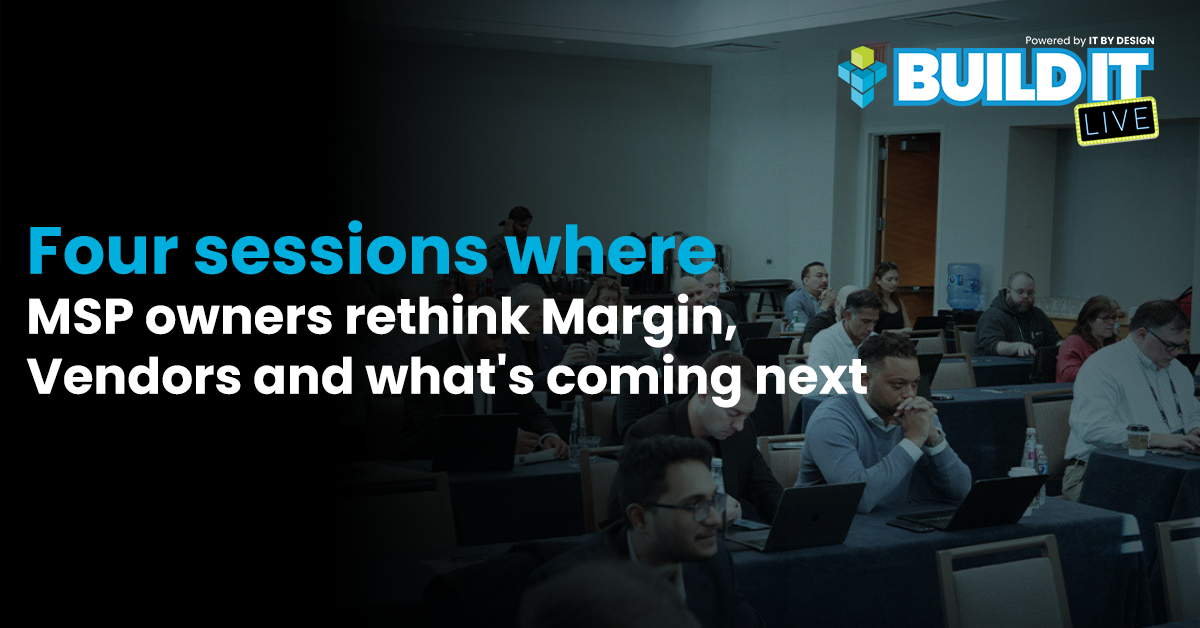
Build IT LIVE 2026 has four sessions built for exactly that reaction. Here’s what to put on your calendar before the good time slots fill up.
Margin visibility, without the guesswork
“The KPIs That Actually Tell You If Your MSP Is Healthy (And the Ones That Lie to You)” tackles a problem most owners feel but can’t quite name. Utilization looks fine. Revenue is up. Bookings are steady. So why does the bottom line tell a different story than the dashboard does?
This session is built for the leadership team that has outgrown vanity metrics. It walks through which numbers actually predict margin months before the P&L catches up, and which popular ones just make you feel good on a Friday. Expect a working framework you can hold up against your own numbers before you even land back home, not a theory you file away for later.
Vendor relationships, minus the sunk cost
“Vendor Consolidation: Rationalizing Relationships Without Losing Leverage or Rebates” is for anyone carrying tools they inherited rather than chose. Most MSPs at scale are running a stack that grew by accident. A tool here from an acquisition, a platform there because a rep was persuasive in 2019, and nobody has run the full audit since.
This session is a practical walkthrough for cutting that stack down to what actually earns its place, without losing the rebate structures and negotiating leverage that come from scale. It’s a rare kind of session, purely operational and immediately actionable, and it often pays for itself in what it saves.
The financial fluency technical owners skip
“The PE Playbook: What Private Equity Is Actually Looking for in MSP Acquisitions” speaks directly to the technical founder who built a genuinely great business and never quite built the financial story around it. You know your NOC inside and out. Do you know how a buyer prices it?
Whether an exit is five years out, five months out, or not even on the radar yet, this is the language buyers, boards, and PE partners actually use to value what you’ve built. Operators who sit through this one tend to leave with a very specific list of what to fix before anyone else ever sees the numbers.
AI governance before it becomes a problem
“Building the Agentic MSP: The Security Integration Layer for Digital Employees” gets ahead of a question most MSPs haven’t asked yet, even though the AI agents are already in the building. As agents start touching ticketing systems, client environments, and internal workflows, who is accountable when one of them gets something wrong?
Presented by Baxter Lanius and Shahin Pirooz, this session lays out the guardrails now, while there is still time to build them properly. It pairs naturally with “Will AI Make MSPs Obsolete? An Honest Assessment,” the Day 2 session asking the bigger question that this one starts to answer.
Why these four, together
Individually, each session solves a real problem. Together, they trace a pattern worth noticing. Margin visibility tells you what is actually working. Vendor consolidation tells you what to stop paying for. Once those two things are sorted out, the PE Playbook puts a number on what your business is worth. And AI governance keeps you from creating a mess you’ll have to clean up later.
That’s the throughline of Build IT LIVE every year. It’s a sharper view of your own business, not a broader one of the industry.
What it costs to be in the room
All four of these sessions, plus 45+ platform CEOs and operators, plus the full-day AI Accelerator on August 5, come in at $1,495 for all three days. That is the complete conference, not a stripped-down pass with the good sessions behind a paywall. The AI Accelerator alone runs $2,500 outside the conference, so the bundle is the better deal either way.
Seats fill fast once the full agenda goes live, and sessions like these tend to fill a room before the rest of the schedule does. Register now and start building a schedule around the sessions that will actually change something, not just the ones with the biggest name attached.