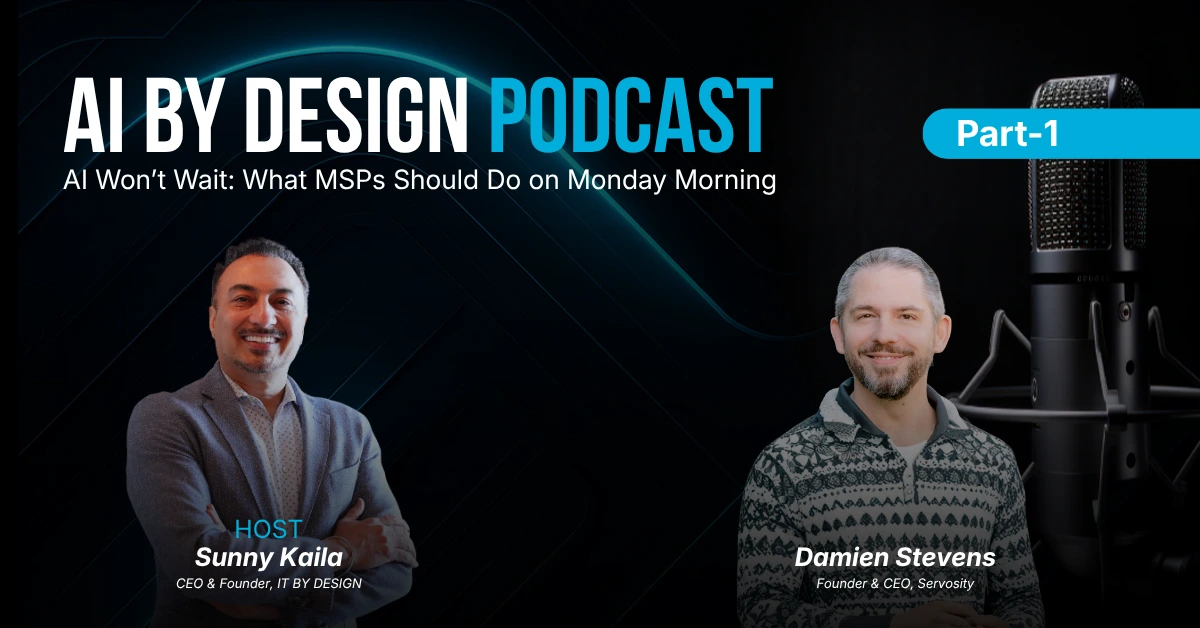
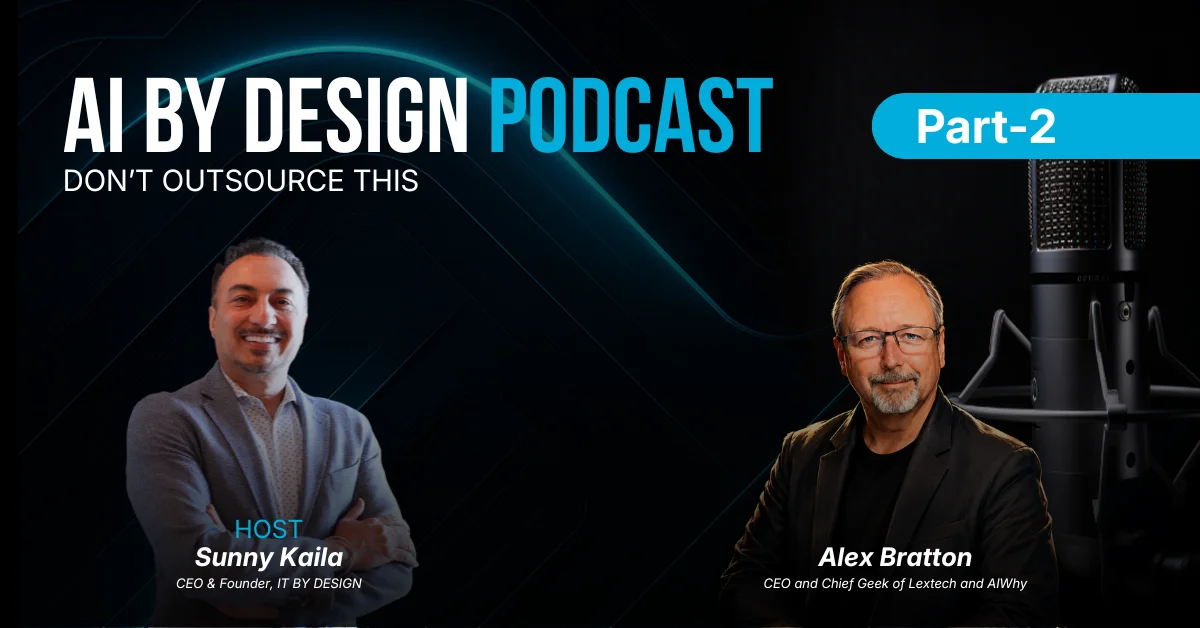
I’ve been building MSPs for 23 years, starting in New York City, the hardest market in the country to earn trust as a technology partner to Wall Street firms. That history is what I brought into my second conversation with Alex Bratton on AI By Design. My question for him was simple: what happens when an SMB’s expectations of its MSP change faster than the MSP itself?
The answer is already happening, and most MSPs haven’t caught up to it yet.
The expectation has shifted
SMBs no longer see their MSP as the company that keeps the network running. They see us as the thought partner responsible for the entire technology roadmap. That used to stop at infrastructure. Now it extends to AI.
I said it directly to Alex: the SMB should not have to go find a separate AI company. They already have a trusted partner. We are supposed to be that AI company.
But there’s a gap, and I know it because I’ve lived it. MSPs tend to be fact finders. We gather information before we move. That instinct served us well in traditional IT. It’s working against us now, because the pace of AI adoption doesn’t wait for a complete picture.
Our clients are asking us to run AI training for their teams, decide where a digital staffer belongs versus where a human stays in the loop, and build the hybrid workforce that protects their margin. Most of us haven’t built that capability internally. The real work is figuring out what to build in-house, what to borrow through collaboration, and what to leave alone entirely.
Forty ingredients, one relationship
Alex named the scale of the problem plainly. An SMB succeeding with AI needs roughly 40 different ingredients. No single company, MSP or otherwise, can supply all of them. That’s not a weakness in our model. It’s the reason collaboration exists.
What can’t be outsourced is the trust. Alex was clear that the relationship between the MSP and the SMB is the core asset, and it belongs to us, not to a partner brought in to help deliver a piece of the work.
Starting with the why, not the tool
Here’s where the conversation sharpened for me. Alex said the shift MSPs need to make is moving past the “you want AI, okay” conversation and into something closer to business consulting. The first question is never about the tool. It’s about the impact the SMB actually wants.
That’s the why. It doesn’t need a formal definition. It needs to be asked, in every customer conversation, starting now. Alex was direct about the timeline: every SMB is already asking how AI changes the way they do business. The MSP that can hold that conversation solidifies its position. The one that can’t gets replaced by someone who will.
The roadmap that filters out noise
When I asked Alex what the first step actually looks like with a new client, his answer was simple: forget the technology for a minute and ask where the business is headed. Revenue growth points toward sales and marketing. Operational efficiency points toward production and delivery. Geographic expansion, acquisition, or a future sale each point somewhere different. For clients running on EOS, the one and three year VTO already contains the answer.
Once that direction is set, the roadmap points AI at it. Alex added a detail I want every MSP reading this to sit with: the surfacing has to include the people doing the actual work, not just leadership, because leaders often misjudge what’s really happening at the edge of the business. From there, the goal isn’t a hundred ideas. It’s ten, filtered by business value against difficulty.
That filter, Alex said, is what keeps a company in the 5% that succeed with AI instead of the 95% that don’t. Most AI opportunities simply don’t matter. The roadmap is what tells you which ones do.
Three layers of empowerment
Alex broke down what empowerment actually requires, and it’s not one thing. At the executive level, it’s an accountability partner keeping the plan moving. Below that are the AI builders already experimenting inside the business, often non-technical people Alex calls the business geeks, who need help turning their instincts into repeatable systems. Below that is the general team, who need something different from training. They need the life skill of finding their own friction and knowing where a tool might apply to it.
That distinction matters to me. Training teaches someone to use a tool. Empowerment teaches someone to recognize where a tool belongs. Tools will keep changing. That judgment won’t.
Alex also flagged a trap I’ve watched MSPs fall into: building large implementations. His approach instead is smaller and faster, what he called adding grease to the engine, blueprints and narrow custom builds that create forward momentum and early wins instead of stalling in analysis.
Where collaboration fits
I closed by asking Alex the question every MSP in my audience needs answered: where does collaboration with a company like his actually happen. His answer was consistent with everything before it. His team will white label services and partner behind the scenes, but the MSP holds the customer relationship. That’s not up for negotiation. It’s the model he’s run for 25 years. His team has done it with Apple, and he’s applying that same approach to AI partnerships now.
We don’t need to become an AI company by ourselves. We need to stay the trusted front door, ask the right questions first, and know exactly who to call for the other 40 ingredients.