I have sat across the table from a lot of MSP leaders.
Some are still hunting for the next piece of software. Some own a shelf full of books they never crack open. And a small number, a rare few, are building something quietly, without noise, that actually lasts.
The difference is not talent. It is not luck. It is not access to capital.
It is how they think.
A few recent conversations brought this into focus again. Different leaders, different rooms, different lessons. But certain lines stuck with me long after the conversation ended.
Here is what I carried away from them.
Part One: Plan With Intention. Never Stop Learning.
One conversation opened with a straightforward question: what is the biggest lesson you would pass on to someone just getting started?
The answer surprised me.
Plan further ahead than feels comfortable.
Most early-stage businesses do not under-plan because they lack ambition. They under-plan because they never sit down and map it out properly, what year one actually looks like, what year three demands, where year five needs to land. A real plan, built early, makes the destination far more likely.
I have watched this play out firsthand. The leaders who carve out protected thinking time, whatever they call it, a thinking chair, a Monday ritual, it does not matter, are the ones whose businesses change shape. Call it what you want. The pattern holds: deliberate pauses lead to real outcomes.
The second lesson was about learning. Not the passive kind. The kind that stacks on top of itself over time.
Look at the entrepreneurs who genuinely scaled, the ones worth studying closely, and you find one shared habit. They never stopped learning. Books. Podcasts. Conversations exactly like this one. We are living through a moment when learning has never been more accessible, and most people still are not using it.
That part hit close to home. Learning is the root of nearly everything I have grown into, not only in business, but as a person. And growth does not stay contained. It spreads to the people around you.
The Problem With Shiny Objects
The second half of that same conversation went somewhere unexpected.
Asked about the most common mistake MSP leaders make, the answer had nothing to do with pricing, hiring, or even tech stack. It was about distraction wearing the costume of ambition.
Peer groups have a name for it: shiny toy syndrome.
Someone attends a conference, gets fired up by an idea, and comes home ready to launch something brand new, before they have finished what was already in motion, before they have wrung the last drop of value from what is already working.
The question almost nobody asks is the one that matters most: how do we make what we already have better?
Even a small gain, one percent, repeated relentlessly across your systems, tools, and processes, compounds into something real. Two percent. Three percent. Stretch that across a year and it becomes significant.
One story landed hard. A peer group member would hear a book referenced and order it on the spot. His wife eventually sent a photo of his shelf: a hundred books, none of them read. Good intentions everywhere. Intention is not the same thing as outcome.
Visionaries are drawn to shiny objects constantly. That is not a character flaw. But the ones who actually scale are self-aware enough to ask a harder question: what am I building right now? What is going unfinished because something new stole my focus?
Collect less. Finish more. Sharpen what is already yours.
Indecision Is Worse Than a Bad Decision
This is something I return to often because I have seen it prove true again and again.
I ran a session with my team not long ago. Two columns. Your worst moment of indecision. Your best decision that turned out badly.
The takeaway from that exercise was simple: a wrong decision beats no decision, every time.
Sitting with unresolved friction, the low hum of anxiety from a choice you refuse to make, drags on a business in ways that compound. It slows down your people. It tells the whole team that stalling is fine. That hesitation is the safer bet.
But the moment you decide, even if the decision is wrong, you generate something valuable: data, learning, proof. That is your version of research and development. That is where real change happens.
Bold decisions only happen if you can tolerate risk, uncertainty, and the discomfort of betting on something no one else believes in yet.
The leaders who win make the calls other people are too afraid to make. If you are willing to do what others avoid, willing to decide what others keep deferring, you will outpace nearly everyone around you.
This is a technology business. The pace of change has never been faster. Stand still and you are already behind.
Perception Versus Perspective
The second conversation took a completely different direction.
Asked for the single greatest life lesson, the answer came fast and sharp.
Perception is seeing a situation only through your own eyes. That is where most of us spend most of our time.
Perspective is something else entirely. It means stepping outside yourself to view the same moment from across the table, factoring in what the other person sees, feels, and carries into the room.
Once you can genuinely do that, everything shifts. You reach conclusions faster. You mediate with more skill. You lead with sharper accuracy. Relationships deepen on both sides of the table, in business and outside of it.
This is not a soft skill.
The MSP business has always been a relationship business. The leaders who can operate through both lenses, not just their own, are the ones who earn trust that actually holds. Who command a room differently. Who close more deals and lose fewer.
I said it in that conversation and I will repeat it here: there is enormous depth in that one idea. An entire leadership philosophy could be built on that single shift.
Flip the Culture Interview
The last idea from that second conversation is the one I keep repeating most.
Most hiring runs in a single direction. The company interviews the candidate. The company judges fit. The company makes the call.
What I heard described flips that completely.
Once a candidate clears the early process and the team feels good about the match, instead of jumping straight to an offer, the candidate receives contact information for people across the organization. Not just leaders. A helpdesk technician. A network engineer. A project manager. Someone in sales. A genuine cross-section of the company.
The candidate is then asked to reach out and interview them.
They get to ask the real questions: what is it actually like here? What does the culture feel like day to day? Why do you stay?
I have not seen this practice anywhere else, and it stands out for two reasons.
First, fit runs in both directions. We usually treat hiring like a one-way filter, which is exactly how misalignment sneaks in. Values mismatch sits at the root of almost every bad hire, and this catches it before day one.
Second, it requires real confidence. Confidence in your culture, your people, your leadership. Letting a candidate interview your team at every level only works if you already know what they are going to say. That tells you something about what you have actually built.
The upside does not stop with the new hire either. Junior employees get pulled into the process. They gain experience. They build ownership over who joins the team beside them.
That is how a winning team gets built. Not just by who you hire, but by how the hiring happens.
What I Keep Coming Back To
Plan with real intention. Keep learning without pause. Look hard at what you already have before chasing what is new. Make the tough call, even when it is uncomfortable.
Then: view the world from both sides of the table. And build a culture you would be proud to hand a stranger and say, go ask anyone.
None of this is complicated. Very few people do it with consistency.
That is the gap. And that gap is exactly where the sharpest MSP leaders quietly build their edge.
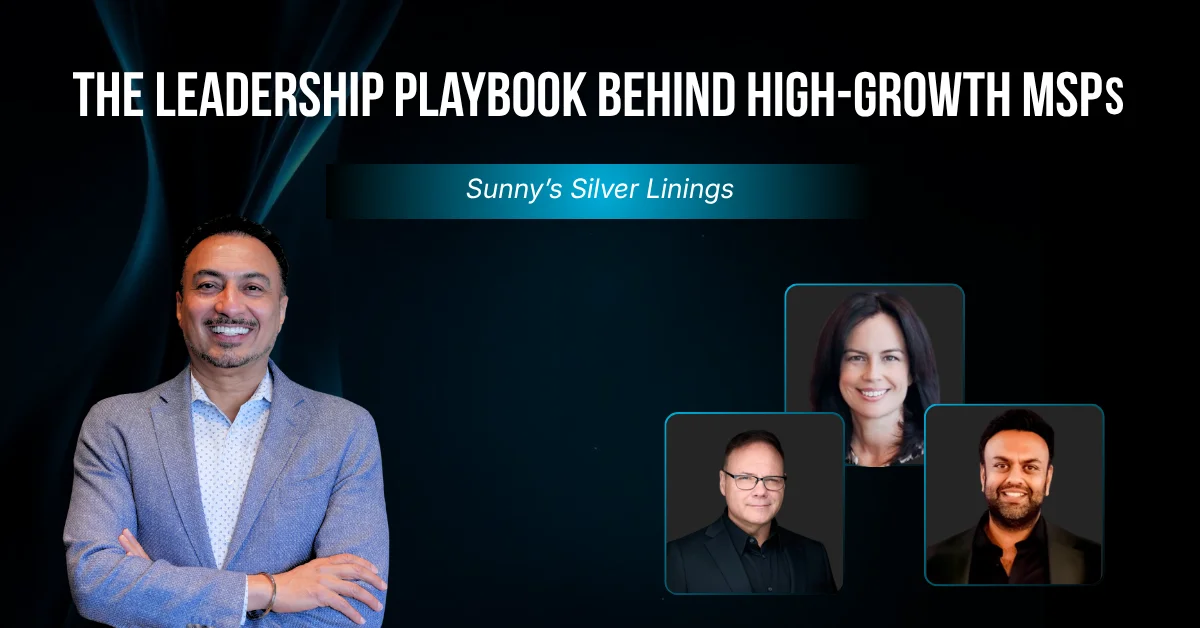
Follow my newsletter, Sunny’s Silver Linings, for more conversations like this one.