Most MSPs are watching the wrong door.
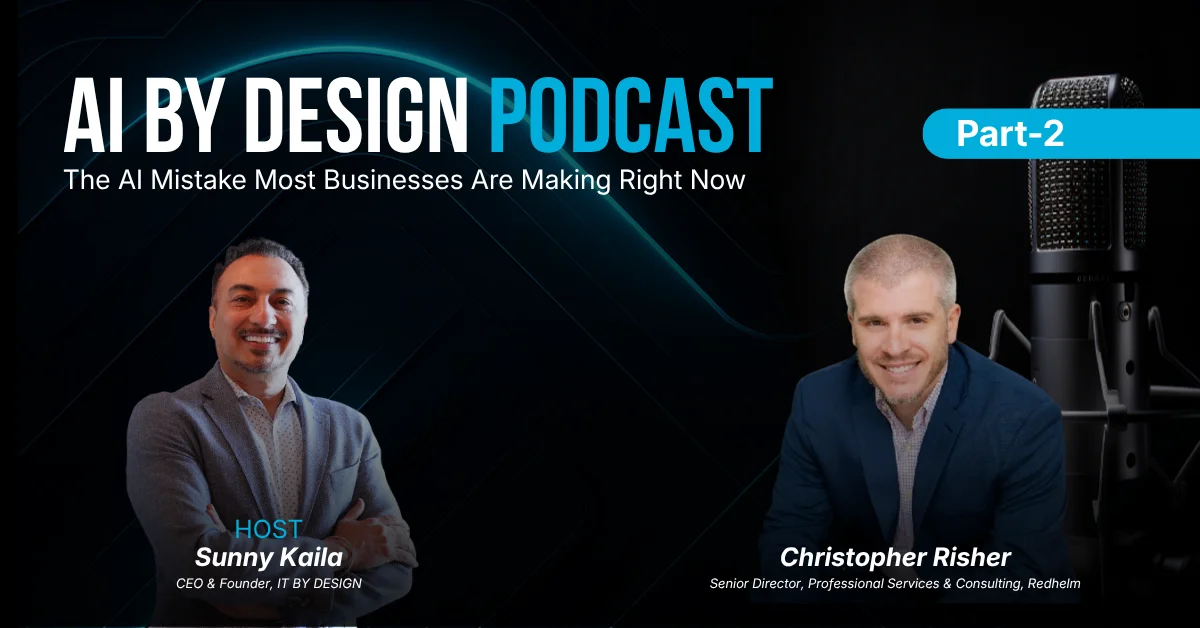
I sat down with Chris Risher from Red Helm for this episode of AI By Design, and about fifteen minutes in he said something that made me stop the conversation: “The fastest way to lose data may not be a hack. It may be a paste.”
No breach. No sophisticated attacker. Just someone on your own team copying sensitive data into a public AI tool because it’s sitting right there in their browser.
Chris has spent 22 years at Red Helm, the Pittsburgh-based MSP and MSSP. He started as a systems engineer, moved through project management and technology leadership, and now runs the advisory and digital innovation practice. He sits with clients on AI governance and agentic implementation every week, so when he talks about shadow AI, he’s describing what he sees inside real organizations.
Start with the why, not the tool
Chris told me the biggest shift in his career was moving from the “how” to the “why.” Digital transformation isn’t about installing technology. It’s about changing how a business produces an outcome. If you’re fixated on the tool, you’ve lost the plot.
It also changed how he hires. He screens for EQ before technical depth, because he wants people who can think past the send button and understand what shipping something does to a client. That’s judgment, and judgment is what scales leadership.
The risk is visibility, not malice
Most security conversations focus on external attackers. Chris is just as worried about internal users, and he doesn’t mean bad actors. He means uninformed ones, people who don’t think twice about pasting a social security number or a credit card number into a public AI tool.
Most IT and security teams can’t see what’s being pasted into which tool, by whom, or when. His fix starts at the paste itself: enterprise browsers that can see and block it, and tools that show what was actually prompted. Then comes the part I found most valuable. That visibility isn’t only for blocking. It’s a feedback loop that shows where your team’s AI maturity really sits, so you can train against the gaps you actually have instead of the ones you’re guessing at.
Governance starts with roles
I asked Chris what an MSP with no AI governance program should do in its first 90 days. His answer went back to something old: role-based access control.
He breaks AI maturity into four tiers:
- Tier zero: free public tools
- Tier one: paid premium chat, like Copilot chat
- Tier two: agentic cowork-style tools such as Claude, Copilot cowork, or Perplexity
- Tier three: full agentic workflows
Think about how ERP access works. An accounts payable manager doesn’t automatically see accounts receivable. Different module, different need. AI access should work the same way. Define the role, match the tier, and build the training around that tier.
What you’ll take away
- Why the biggest AI data risk is internal, not external
- How prompt visibility becomes a training feedback loop
- How to apply role-based access control to AI tools
- How to define AI usage tiers, from free tools to agentic workflows
- Why finance, HR, service delivery, and sales each need AI differently
The shift isn’t more tools. It’s better governance around the tools you already have.
Part 2 picks up where this leaves off, with the ROI reality check and the question of who is actually accountable for making AI work.
Watch the full episode on YouTube, and follow IT By Design on LinkedIn and YouTube for more conversations like this. You can also explore our on-demand learning platform, Build IT University.