The Pressure Is Real. The Plan Is Missing.
Most MSP leaders I speak with are not struggling to see the opportunity in AI. They are struggling with the pressure to move before they understand what they are moving into.
I had a conversation recently that clarified something for me. The guest put it plainly: AI for MSPs is not a growth opportunity in the traditional sense. It is not an addressable market you analyze from a distance. It is a survival game. Get on board, and you capture the benefits. Stay on the sidelines, and the train runs you over.
That framing matters. Not because it is dramatic, but because it changes how you plan.
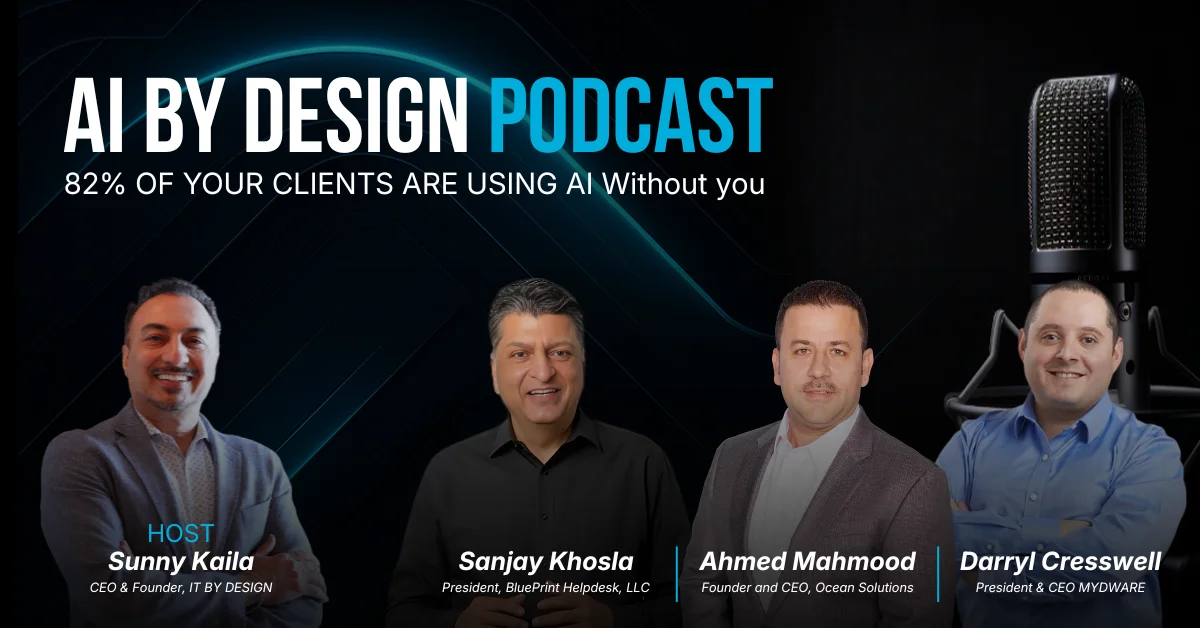
Here is the number that reframes the urgency. 82% AI adoption already exists in the SMB space in some shape or form. It may be as simple as someone in marketing using ChatGPT or Copilot to generate emails. But it is happening. The question for MSP leaders is no longer whether their clients are using AI. It is whether they are using it safely, strategically, and with the right foundation in place.
When that is the lens, the question stops being “should we adopt AI?” and starts being “what does responsible AI adoption actually look like for us and for our clients?”
Here is where I see most MSPs getting it wrong.
There is a pattern in this space where leaders watch what others are doing with AI and try to replicate it. Someone says use it for writing. Someone else says use it for this workflow. And so leaders go implement that. But copying another company’s use of AI is like wearing someone else’s shoes. It fits their problems. Their limitations. Not yours.
The same logic applies when MSPs are guiding their SMB clients. What works for an R&D shop trying to make engineers AI-enabled is not the same thing an SMB client needs. The SMB needs to apply these technologies within the context of their own industry. That is a fundamentally different exercise.
So what does a thoughtful approach look like?
The Sequence That Actually Works.
Start with education. Not with tools. Open the minds of department heads and the people doing day-to-day work. Let them sit with what AI actually is, why it exists, and what it can do. Then step back. Let them come back with where they see it fitting in their own work.
That exposure creates something that technology deployment alone never does: internal buy-in. When people understand what is possible before they are asked to change how they work, adoption becomes a pull rather than a push.
From there, the path becomes clearer. Give clients the ability to interact with their own data in new ways. Then move to small workflow automations. Eventually, where it makes sense, help them build agents. That sequence builds confidence at the client level before capability is stretched.
And this sequence has a direct impact on service margins. When MSPs use better prompting and purpose-built agents inside their own service delivery, the cost to serve drops. That is not a future benefit. That is something happening now for the operators who are building this deliberately.
The guest I spoke with is already on this path. And the signal he sent about where his business is going was direct: 75% of future marketing and sales focus will be on AI services. His MSP practice continues, but he is building a dedicated AI agency alongside it. That is not a pivot born out of hype. It is a calculated bet based on where client demand is heading and where the real margin opportunity sits.
Now here is the part that does not get said enough.
Security and Governance Are Not the Brakes. They Are the Foundation.
Cybersecurity has not become less important because AI arrived. It has become more important. When you are integrating third-party AI applications into Microsoft 365, into CRMs, into ERPs, the attack surface grows. If those tools are given more access than they should have, or if boundaries are not established, information can leak. Sensitive data can end up somewhere it should never be.
The prediction is direct: there will be a significant number of AI-related security compromises in 2026. And most of them will trace back to implementations where cybersecurity was not the foundation.
Security first. Then governance.
Governance is not a compliance checkbox. It is the structure that determines what employees can do with AI and what they cannot. It is use policies. It is guardrails. It is the difference between an organization that adopts AI confidently and one that adopts it recklessly.
This is the role the MSP plays right now. Not as a vendor selling tools. As a trusted advisor who brings the guardrails before the keys. Who helps clients adopt AI with both capability and protection in place.
The MSPs who figure this out early are not just capturing a new revenue stream. They are repositioning themselves as the partners their clients will not leave when the next wave of technology arrives.
Security first. Governance second. Education always.
That is the sequence. That is what thoughtful adoption looks like.