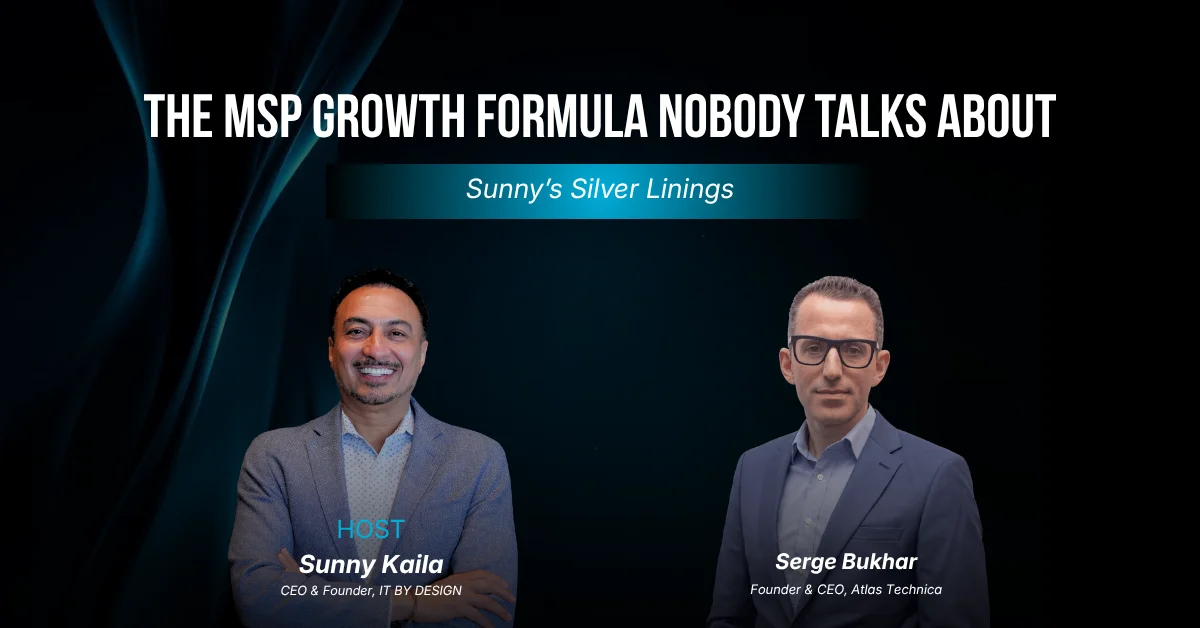
Serge Bukhar never planned to be an entrepreneur.
He spent the early part of his career as an engineer. Grew inside an MSP from 80 people to 400. Watched how the business worked from the inside. Then decided to build his own.
Ten years ago he started Atlas Technica.
The focus was narrow from day one: the alternative investment industry. Hedge funds. Private equity firms. Boutique asset managers. A vertical most MSPs were not serving the way it deserved to be served.
Today Atlas Technica has 400 employees globally.
90% of their client base is still in that same vertical.
Same industry. Same obsessive focus. Completely different scale.
What Most MSPs Get Wrong
When I asked Serge what he did differently, the answer was not what most people expect.
It was not a sales strategy. It was not a marketing playbook. It was not a technology edge.
It was service delivery.
“Most MSPs focus on the wrong things,” he said. “They focus on sales and marketing. They focus on technology and operations. And what is often forgotten is service delivery.”
Atlas Technica is a pure play MSP. They act as a full outsourced IT department. Desktop. Networking. Cloud. Cybersecurity. Everything delivered as a package.
But the real differentiator was never the stack.
It was the people delivering it.
Their internal belief: keep employees happy and they will keep clients happy. That simple logic drove how they recruited, trained, and retained talent from the beginning.
Measured Growth Is a Strategy
Most MSPs chase growth.
Serge managed it.
“Unbridled growth that is uncontrolled is a bad thing,” he said. “It will overwhelm your employees, your systems, your business.”
Atlas Technica has always operated with what he calls measured growth. Not reckless expansion. Not chasing revenue at the cost of delivery quality.
That discipline is part of why the service model held as the company scaled.
Growth without operational readiness breaks the thing that made you worth growing in the first place.
Three Pillars Driving the Next Phase
Serge is clear about where Atlas Technica is focused now.
Three things.
Growth. AI. Operational maturity.
On operational maturity, he specifically referenced the Connectwise Service Leadership Operational Maturity Index as a framework they follow. The idea is building out all parts of the business systematically, not just doubling down on the one thing that got you here.
For Atlas Technica, service delivery drove the first five years. The next phase requires every part of the business operating at the same level.
That is what the Operational Maturity Index is designed to do.
Getting Internal AI Adoption Right
About a year and a half ago, Serge identified three priorities for Atlas Technica around AI.
First: internal employee adoption. Second: building the right internal systems. Third: helping clients implement AI.
The employee adoption piece came first.
They implemented Glean, a front end to large language models that allows employees to switch between ChatGPT, Claude, or Copilot in the back end while keeping the workflow consistent. Employees could ask questions about company knowledge and external knowledge in one place.
The feedback was immediate. People were using it daily. Instead of tracking down the right person to answer a question, they went to Glean.
Beyond the tool, communication mattered just as much. Monthly all-hands. Hackathons. Giving employees the ability to build their own agents. Leadership reinforced one message consistently: AI is no longer optional. You cannot sit on the bench and wait to see what happens.
And when some employees showed fear, Serge addressed it directly.
“AI is not going to take your job. But a person who uses AI better than you will.”
That framing shifted things.
It was not a threat. It was the truth. And it gave people a reason to move.
He also made one more observation. As adoption grows, certain employees start to emerge. Forward thinkers who want to drive AI change inside the company. The job of leadership is to incentivize those people, not lose them to frustration when the rate of change feels too slow.
The Client Side Is Different Now
Six months ago, something shifted with clients.
“Most firms realized that they need to start using AI,” Serge said. “Prior to that, it was a little harder to get clients excited.”
Atlas Technica operates in the alternative investment vertical, which tends to be on the bleeding edge of technology. Their clients moved earlier than most. But Serge’s point was broader.
Every business has an AI use case today.
He referenced a two-person pizza joint that replaced a part-time phone order taker with an AI solution during busy hours. The business size did not matter. The vertical did not matter.
The opportunity is everywhere.
What matters is having the right people on your side who can uncover what the client actually needs. Those needs might be around security. Around utilization. Around data exfiltration concerns. The entry point varies. The conversation needs to happen.
And it needs to happen now. Because if you are not having it, someone else will come in and have it instead.
How Serge Is Thinking About AI Vendor Risk
The AI market is noisy.
Serge watched the dotcom bust at the start of his career. He sees the same pattern forming now.
“There are going to be a few big winners,” he said. “And most AI firms will likely die off.”
His strategy is not to ignore AI. It is to hedge.
Atlas Technica is not betting everything on one vendor or one platform. They are evaluating multiple approaches simultaneously. Testing what delivers results. Keeping flexibility if a vendor does not survive the consolidation.
The warning he gives: if you spend all your time and energy building your practice around one vendor and that vendor goes out of business, you are back to square one.
Stay educated. Read newsletters. Participate in peer groups. Make sure you know when the market pivots so you are not still marching down the wrong path.
The Closing Thought That Matters Most
I asked Serge for the one thing he would want every MSP to remember.
His answer was not about AI.
It was about listening.
“Care about your employees. Listen to your employees. Because probably some of the best AI ideas will come from them. You just have to listen for them.”
He talked about creating safe spaces for employees and clients to surface ideas. Advisory dinners with clients. All-hands where the floor is open. Internal AI advisory teams where employees who want to engage can raise their hands and contribute.
The best ideas inside your business are already there.
The job of a leader is to create the conditions where those ideas can be heard.