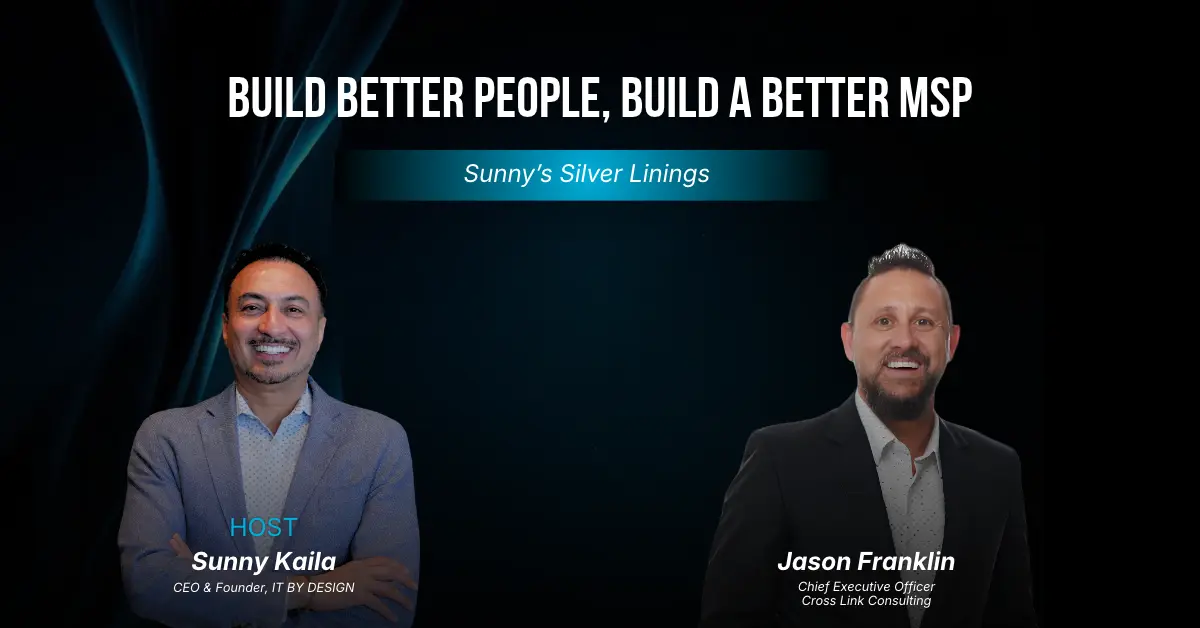
Yesterday was Veterans Day, and I spent part of it penning this blog about Jason Franklin. He served in the United States Army for more than two decades before he ever ran an MSP.
Jason, thank you for your service. Thank you as well for the hour you gave me on Sunny’s Silver Linings. I wish you every success in your new role as CEO, and I wish every veteran and military family reading this a year of health and peace.
I learned a lot from Jason, so let me share it.
Five minutes is what it costs Cross Link Consulting, on some tickets, to keep a person in front of the client when the automation running in the background could have finished the job alone. Jason Franklin knows the number. He pays it on purpose.
I sat down with Jason on Sunny’s Silver Linings a couple of months after we connected during Build IT LIVE. The week before we recorded, he was named CEO of Cross Link Consulting, an MSP in North Augusta, South Carolina that has served its neighbors for more than 20 years.
What stayed with me is that Jason holds two positions most people treat as opposites. He believes a technician who refuses to use AI is headed for a short career. He also refuses to let a machine answer his phone.
Somehow, he is right on both counts, and while he explained it on the podcast, I share my thoughts here.
The Army Trains Its Leaders on Purpose
Jason joined the United States Army at 17 and served until he was 40. He told me he was “cyber before cyber was cool,” an IT technician back when computers were first being used so soldiers could communicate across a battlefield. He saw combat. He retired as an IT planner whose core job was networks and the people who maintain them.
I asked what the military taught him about leading people that most MSP owners never learn. His answer came down to intention. The Army takes an officer from leading 20 or 30 soldiers to being responsible for hundreds, and it does not leave that growth to chance. There are courses for it, and there is coaching at every step.
Now look at how the rest of us do it. Benedictine University surveyed 544 managers this summer for its Accidental Manager Index, and Forbes returned to the findings on October 31.
- 77% were promoted into their first management role with no formal training.
- 25% were promoted because they had shown they could lead.
Both could be the MSP story. We take our best engineer, hand them a team, and call it a promotion. Then we wonder why the service desk loses a great technician and gains a struggling manager.
Jason gave a peer at Build IT LIVE advice. The owner was wrestling with organizational and leadership problems, and Jason told him to find a retired Army officer. They know conflict and stress, he said, but what they have above all is a career spent identifying and building leaders.
I wrote in my first book, Talentpreneurship, that if you know how to find great people, keep them, and keep them connected to your vision, you can win in any industry. Jason spent his years in uniform learning exactly that skill.
Everything Is a Process, and AI Just Removed the First Step
I asked Jason for the greatest life lesson the Army gave him. He did not hesitate. “Everything is a process.“
His technicians are in their early 20s, and he says they want everything now. They grew up with microwaves and video games. Life does not work that way, and nobody gets to the top in record time. Coaching, in his words, is making sure you are ready for the next piece.
Here’s what struck me. That process used to have a first step built in. A new technician reset passwords, wrote up documentation, summarized the ticket history, and learned the business by doing the small things. On October 26, ZipRecruiter’s 2026 AI Worker Report showed where those small things went. The tasks people hand to AI most often are research, summarizing, and drafting, the same tasks that used to teach a new hire the job.
The same report shows who is getting help with the change.
- 83.5% of senior leaders have received AI training from their company.
- 45.3% of entry-level workers have.
- 54.7% of entry-level workers are teaching themselves.
So the people at the bottom of the ladder have lost their training ground and are receiving the least instruction. Jason is right that everything is a process. The part I would add for MSP owners is that the process no longer happens by accident. If an agent closes the password resets, somebody has to decide what a first-year technician does instead and who coaches them through it.
Jill Chapman of Insperity spoke to me about this in July. Pull back on early talent now and in three to five years there is nobody ready to manage. Kaseya’s 2026 State of the MSP Report already shows the pressure. The share of MSPs struggling to hire skilled technicians went from 9% to 16% in one year.
Build Better People, Build a Better MSP: What Jason Franklin Taught Me About Leading in the AI Era
Cross Link Consulting’s hiring process has four steps. The final interview alone keeps a candidate in the office for four or five hours. The point is to find out whether this person can live the company’s values, which he was clear are more than a poster on the wall.
The same standard continues after the offer. Every team member is evaluated twice a year. Before that conversation, they write a self-assessment showing where their work matched the company values. Jason tries to hold each evaluation for 90 minutes.
Why spend that much time? Because, he said, then they stay. He shared an old exchange between a CFO and a CEO. The CFO asks, “What if we invest in all these people and they leave?” The CEO answers, “What if we don’t, and they stay?”
Jason’s own version is plainer. “If you build better people, you’ll build a better business.“
I told him what I have seen in my own company. People who are learning and can see a path in front of them rarely leave. When one does, count that person as a plus in your life, because you added value to them and they will remember it. How many people we lift in a lifetime is the measure I care about.
Hire for What Does Not Expire
I asked Jason for one thing an MSP leader could change in hiring on Monday. He borrowed from the author of book The Ideal Team Player, Patrick Lencioni, and gave him the credit: find out whether the person is humble, hungry, and smart.
Humble means teachable. Hungry means they want to work and learn. Smart is the one our industry gets wrong, because we hear the word and think of intelligence. Lencioni means something else, and Jason translated it the way an Army mentor once did for him. Can you do your job well and play nicely with others? If you can do those two things, there is not much you cannot become.
Cross Link Consulting says as much on its careers page. Bring the character and the willingness, and they will teach you the technology.
That order matters more this year than it did last year. In the ZipRecruiter data, 44.6% of workers say AI is making their technical skills go out of date faster. Among people who use AI every day, the figure is 67.3%. A certification has a shorter shelf life than it used to. Character keeps.
The Candidate Who Called AI a Fad
A candidate sat in a Cross Link Consulting interview and said AI is a fad. It will go away, the candidate argued, because people want human connection.
Jason’s reasoning differs. No single person can keep up with the volume of change in our field, and AI is how a technician stays current. The question gets asked all day: did you run that through Claude? Then the technician goes back to the client and explains what was done. Nobody mentions the tool, because a client does not care how you solved the problem.
Clients need them to do their job so they can do theirs. If AI helps do that better, he told me, “I would be irresponsible in not doing that.”
The candidate was half right. People do want human connection. The mistake was treating that as a reason to refuse the skill. I have said for a while that AI is not software. It is a skill, and a skill gets built through daily use.
The Five Minutes
Then the conversation drifted to how an MSP stays human while it automates. Jason said there are compromises he thinks he will not make.
When you call the office, a person answers. You never get a computer. He knows that costs money. Cross Link Consulting automates a lot and is building more, but the aim is to keep it invisible to the client. Even when something in the background is producing the fix, a person is the one in front of the client. It might cost five more minutes, he said, and what they get out of those five minutes is invaluable.
That’s the shift right there. Automation goes backstage, and the person stays at the front door.
Two studies say clients want this exact arrangement. Gartner surveyed 3,566 customers and reported in August that half of them find service easier when a company uses generative AI. In the same survey, 87% said the option to reach a human is essential. People are fine with the machine doing the work. They want to know a person is there.
On November 9, NiCE and Metrigy published their third-quarter consumer index, and it reads like a description of Jason’s policy. Trust was the top factor people weigh when they deal with a business. 63.9% said they would pay more for better service, and the feature they most wanted to pay for was the choice between AI and a person. Patience is shrinking too. Consumers now put up with 2.78 bad experiences before they leave, down from 3.24 at the start of the year.
Jason told me the human element is a bigger money maker than you can measure some days.
I also think about agents the way I always have: humans think, agents act. Let the agent do its acting in the background. Keep the greeting with your people.
A Question Is an Invitation
I closed by asking for one piece of advice for CEOs. Jason does not come from a deeply technical background, and he leads people who do. His advice was to stop needing all the answers and to stop getting defensive when the questions come. He quoted Andy Stanley: a question is an invitation. It invites you to be better and to consider an idea you would not have reached alone.
Shahin Pirooz told me in September that pride is the biggest risk in our channel. Jason handed me the daily practice that answers it. Want the questions.
His advice for everyone else working in an MSP took one sentence. Use the technology, and do not lose the human touch.
Let me bring this together. Jason learned to lead in an institution that trains leaders on purpose. He now runs an MSP where technicians are expected to use AI on every ticket and a person still picks up the phone. Most of us were told to choose one. The research from this October and November says clients will pay for both.
So here is a Monday exercise. Find the five minutes in your service delivery that a client would miss if a machine took them over. Automate everything around those five minutes, and protect them.